
MESA propels interest in science

Scientific experiments don’t always work the way they are supposed to.
That’s what some young scientists at the WSU Spokane Mathematics Engineering Science Achievement competition found out Tuesday.
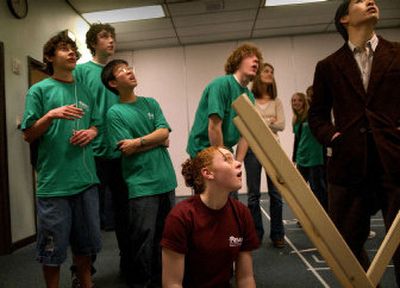
“I don’t understand,” said a frustrated Jessica Bower, 14, whose medieval catapult device, known as a trebuchet, kept launching a small Hacky Sack into the ceiling instead of forward at Spokane Falls Community College. “Why won’t it work?”
Two practices had yielded better results, and previous scientific analysis showed the device should at least fire straight.
Bower’s freshman team from North Central High School, which included her and Ashley Sillivan, 15, spent nearly two months building its trebuchet and putting together a presentation complete with data for the competition.
“They didn’t run as many tests as everyone else,” concluded teacher Jennifer Berg.
And so the top prize – Apple iPods – went to a team from Ferris High School. Another team from Ferris won second place. Teams placing in the top five also received flash drives to store data on computers.
The competition is sponsored by MESA, a statewide organization that targets students of color and female students in an effort to get them interested in careers in math and science.
At least one MESA class is taught at Spokane public middle and high schools, where students attend regular math and science courses but also have access to what MESA has to offer, including the competition and trips to local colleges.
“This is hands-on stuff, with a lot of enthusiasm,” said Joann Moznette, a Spokane MESA program coordinator.
The annual competition centers on the scientific inquiry of topics and includes about 200 ninth- and 10th-graders from Spokane Public Schools.
While the freshmen concentrated on the building and testing of trebuchets for the competition Tuesday, the 10th-graders, who compete Thursday, get to choose a project in any scientific discipline.
The 10th-graders are also vying for a spot at the Washington state MESA competition in Seattle in May.
To win, teams submit a technical paper documenting their experiments and then an oral presentation for local professionals who work in the fields of science and engineering, including for such companies as Avista.
“They test it for engineers and scientists, so it’s very real,” Moznette said. “They really have to know their stuff.”