
Security Council puts pressure on Iran
UNITED NATIONS – The Security Council called on Iran on Wednesday to suspend its uranium enrichment program within 30 days, ending three weeks of deadlock between Western powers and Russia and China over how to pressure Tehran to prove its nuclear efforts are not aimed at making weapons.
The 15-member council unanimously adopted a nonbinding statement on Iran after the U.S. and five other key countries finished difficult negotiations on its wording. The statement does not commit the U.N. to action against Iran and was crafted to avoid language that might clearly set the stage for sanctions or subsequent military moves – the sort of direct pressure that Russia and China have declined to support.
But U.S. and other Western officials said the Security Council’s action – its first unified statement on Iran’s nuclear program – represented an important breakthrough and could set the stage for a tougher line later if Tehran refuses to meet the council’s demands. Secretary of State Condoleezza Rice was set to meet today in Berlin with foreign ministers of Russia, China, France, Britain and Germany to map out the next steps in confronting Iran over its nuclear program.
“Iran is more isolated now than ever,” Rice said in a statement after the vote. “The Security Council’s Presidential Statement sends an unmistakable message to Iran that its efforts to conceal its nuclear program and evade its international obligations are unacceptable. The international community expects Iran to comply with the International Atomic Energy Agency’s call to suspend all enrichment-related activity and to return to negotiations.”
Iran’s U.N. ambassador, Javad Zarif, told reporters that his government had not decided on a formal response but that Iran will never give up its right to produce nuclear fuel for a peaceful nuclear energy program.
“Iran will want to cooperate with international community but it does not accept pressure or intimidation,” he said. “We have made it clear at highest levels of government Iran does not want nuclear weapons nor does it want to pursue development, stockpiling or acquisition of these inhumane weapons.”
The council accord was struck just hours after Rice urged Russian Foreign Minister Sergei Lavrov during a telephone call to support a French and British draft statement urging Iran to suspend its uranium enrichment within 30 days or face increased, but unspecified, international pressure. The statement also calls on Iran to fully cooperate with the U.N.’s nuclear watchdog, the IAEA, which conducts inspections aimed at preventing the spread of atomic weapons.
U.S., British and French diplomats secured Russian and Chinese support by offering concessions that softened the tone of the statement, which was read by the council’s rotating president, Cesar Mayoral, of Argentina. They included extending the deadline for Iranian compliance from 14 to 30 days, and dropping language hinting that Iran’s nuclear program constituted a threat to international peace and security.
The agreement on the statement masked persistent divisions among the Security Council’s five veto-wielding powers over the threat of sanctions or the military force to compel Iranian cooperation.
Lavrov said in Moscow that “any ideas involving the use of force or pressure in resolving the issue are counterproductive and cannot be supported.”
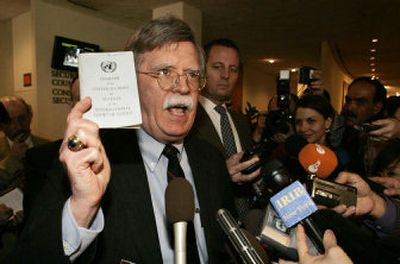
John Bolton, the U.S. ambassador to the United Nations, insisted that the Security Council, which is vested by the U.N. charter with responsibility for responding to threats to international peace and security, has the obligation to prevent Tehran from producing nuclear weapons. He expressed frustration that Moscow and Beijing had blocked language in the statement highlighting the council’s obligation to react to such threats.
“What happened here today is that Russia and China declined to quote from the U.N. charter,” said Bolton, waving a copy of the charter. “We accept that … because the message is clear nonetheless that Iran’s nuclear weapons program is unacceptable.”