
Paying the freight

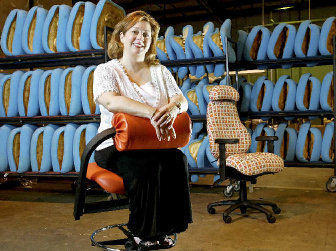
NEW YORK — Rebecca Boegnik has had to go ahead and raise prices, while Rebecca Herwick is keeping more inventory on hand. And Blair Whitworth’s company is using technology to accomplish the tasks that used to be done on road trips.
For small business owners like these, the problems caused by soaring energy prices go far beyond filling gas tanks. Freight costs are continually rising, materials are getting more expensive by the month and travel is becoming too costly. Companies are finding whatever ways they can to cut costs, but many are faced with the prospect of raising their own prices — a move they fear could hurt their competitiveness.
Two years ago, a barrel of crude was selling for $40, an astronomical sum at the time. Now, it’s in the low $70 range, while gasoline, which sold for about $1.80 in early May 2004 now costs over $3 in many places.
“It’s an interesting dilemma,” Boegnik said of rising prices.
Boegnik said her freight costs, measured as a percentage of sales, went from 3 percent in recent years to their current level of 7 percent, or from $650,000 a year to $1.4 million.
But that’s only part of the problem. Her Bryan, Texas-based company, Neutral Posture Inc., uses a lot of plastic, made from petroleum products, in its chairs. And it uses steel, which has become more expensive because of the high volume of energy used in its production. Some components are specially manufactured for her.
Like other small business owners, Boegnik has cut costs where she could, but she’s also been forced to raise her prices, the first time two years ago, and again recently. That’s a nerve-racking step — it makes her worry about being competitive in an industry with several hundred manufacturers.
“Because we’re a small player, we never take the lead” in raising prices, she said.
Hallie Satz, who owns High Road Press, a commercial printer in New York, said freight carriers imposed a temporary surcharge after Hurricane Katrina.
“Then they took away ‘temporary,’ she said.
Like Boegnik, Satz is also dealing with rising costs in the materials she needs. She’s been getting a stream of notices of price increases, including three in just about 24 hours. Some of the biggest increases have been in paper, and Satz reported five since Katrina hit the Gulf Coast last August.
Satz said she’s been absorbing as many of the price hikes as possible, but she does have to pass on the higher paper prices to customers. It’s troubling because of the high number of competitors, and because her customers, worried about their own costs, aren’t likely to expand their own budgets.
She also said she’s had to “put a lot of things on the back burner,” including some construction projects.
Herwick is cutting down on freight costs by getting larger deliveries to her St. Peters, Mo.-based company, Global Products, which manufactures clothing and collectibles under brands including Harley-Davidson. She reported having to pay freight surcharges of up to 25 percent.
That’s saving Herwick some money, but, like many solutions to energy price problems, this creates another difficulty.
“It means a bigger hit on end of year tax issues because of my inventory valuation,” she said.
There are ways to help mitigate some of the damage, especially through the use of technology. Perhaps the most common method is using teleconferencing or videoconferencing instead of traveling to meetings.
At PRO-TAX, an accounting and tax preparation service based in Charlottesville, Va., the solution was to use an information technology system that allowed the company to remotely install new software at its 24 locations in Virginia, West Virginia and Tennessee.
Whitworth, the company’s president, estimated that the change has saved PRO-TAX $5,000 a year, but he noted that the number is based on an outdated mileage allowance figure, and that the savings is probably higher given the recent surge in gas prices.
“Before, we used to do two to three visits to each office a year; now we do one visit,” he said.
There are additional steps small businesses can take to shave their energy bills.
One is to make as few trips as possible, and to schedule errands or deliveries using the most efficient routes. Mapping software — including online services such as Yahoo Maps, Google Maps or MapQuest — can help you find the shortest distance between two stops.
A lot of fuel is wasted idling; employees should turn off the engine when they’re not in motion. You can get a sense of whether they’re listening by the amount of gas they’re using and how it corresponds to the length of the trips they’re making.
Anyone with gas-powered equipment, such as landscapers, should be certain that the motors are operating efficiently.
Businesses can also save on heating, cooling and electric bills. Using motion detectors to turn off lights in empty offices, energy-efficient appliances and setback thermostats — which use timers to regulate temperature — will all help. And manufacturers should be sure their equipment is well-maintained.