
Episcopalians’ choice averts crisis
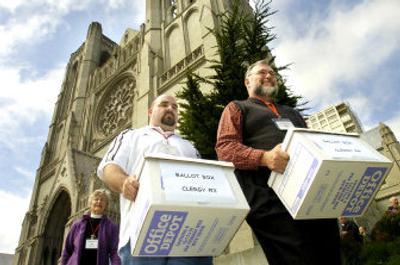
SAN FRANCISCO – The story from Grace Cathedral on Saturday was not so much about what happened but what didn’t happen. Episcopalians in San Francisco did not elect an openly gay candidate as bishop of the Episcopal Diocese of California, thereby preventing a schism within the 75 million-member Anglican Communion already on the verge of crisis after electing its first gay bishop in New Hampshire three years ago.
Instead, about 700 voters representing clergy and laity chose Mark Handley Andrus, a violin-playing, yoga-practicing father of two, currently the bishop suffragan from the Diocese of Alabama. Andrus, who will be succeeding retiring Bishop William Swing, told the voters in a phone link from his home in Alabama that he was “glad and humbled by the trust you have placed in me.”
Andrus ran against six other candidates. Three of them, the Rev. Michael Barlowe of San Francisco, the Rev. Robert Taylor of Seattle and the Rev. Bonnie Perry of Chicago, live openly with same-sex partners, prompting pundits to predict that the diocese, based in a city with a powerful gay movement, would elect a homosexual chief. But from the start of voting Saturday, it was clear that none of the gay candidates would win; Perry, the sole lesbian among the group, dropped out of the race after the second round when she garnered only one vote.
The election, which took three rounds in the airy cathedral atop historic Nob Hill, was significant because if the diocese had chosen a homosexual as bishop it could have prompted the expulsion of the U.S. church from the Anglican Communion, or compelled a majority of the communion’s other provinces to boycott the communion; in short, a full-blown schism.
Since the election in 2003 by the New Hampshire diocese of V. Gene Robinson, the first openly gay bishop in Anglican history, conservative Anglicans have urged the Episcopal Church of the United States to stop even considering the election of gay bishops.
The furor over sexuality underscores the increasingly stark divisions between the communion’s liberal bastion in the United States and its conservative strains, represented by some U.S. clergy, but more significantly among the church’s biggest growth areas in Africa, South America and Asia, now home to more than half of all Anglicans.
The Rev. Ian Douglas, professor at Episcopal Divinity School in Cambridge, Mass., who co-chaired a committee that recommended in April that the U.S. church “exercise very considerable caution” before consecrating any more gay bishops, said the Anglican community had moved rapidly in the past 50 years to bring “historically marginalized voices” into the church. In the West, that has meant women, laity, homosexuals and lesbians and ethnic minorities. In Africa, Asia and Latin America, that involves “historically colonized poor people.”
“What we need to be careful about is not playing one marginalized community off the other,” he said. “The reality of differences is not going to go away because of one election.”
The Rev. Robert Duncan, the bishop of the Diocese of Pittsburgh, who has led the charge against Robinson’s election, was clearly relieved that Saturday’s victory did not go to an openly gay person. In a written statement, he said he was “grateful” the diocese had chosen Andrus.
“Our very claim to be `Anglican’ remains in jeopardy and we have yet to clearly respond,” he said. The Episcopal Church will next confront these issues in June during its general convention.