
Seniors show off moves
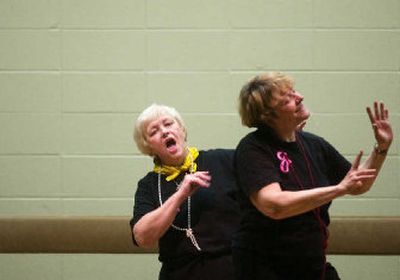
The clickity-clack, rattity-tat sounds of tap shoes pounded out a beat from the open door of A Time to Dance studio.
Joan Hamilton’s beginning tap class was hard at work.
These students were no tiny tots in leotards, however. They were the Tap Grandmas’ beginning class, whose members range in age from 50 to 75.
“My dad was a hoofer,” Hamilton recalled. “He performed vaudeville at the old State Theater and made sure my twin brother and I had tap lessons when we were young.”
Newly retired after 23 years of teaching physical education, Hamilton wasn’t ready to sit in a rocking chair. So she gathered a group of retired teachers and formed Tap Grandmas.
That group of four has now evolved into nine performing members plus the seven members of her beginning class.
Twice a week they shimmy into the studio to rehearse. The rehearsals are a combination aerobic workout, dance party, and girlfriends’ morning out.
Gena Bradford, 59, said, “Tapping is a great stress reliever.”
Grandma Joan Frank, 68, noted, “It’s exercise that’s pure joy.”
Joy was evident as they tapped and shim-shammed across the floor.
Assistant choreographer Dennie Crow said Tap Grandmas has given her a fun group of new friends. She called the group a “bonus” result of retirement.
A couple of times a month the grandmas take their show on the road. They’ve performed for several groups, but their true love is visiting elementary schools.
“Rhythm tap is a dying art form,” said Hamilton. She and her hoofing colleagues delight in presenting it to a new audience.
Audubon Elementary Principal Greg Baerlocher said, “Eighty percent of our students are in the free and reduced-price lunch program. Many have not been exposed to the arts in this way.
“Tap Grandmas did a fantastic job getting the kids involved.”
Eager student volunteers were pulled onto the stage to learn tap moves.
“The staff enjoyed it as much as the students,” Baerlocher said. “Our PSO (parent service organization) has already scheduled them for an encore performance.”
Garfield Elementary Principal Joann Ekstrom admitted to wondering whether the grandmas could hold the attention of a preschool-through-sixth-grade assembly.
“Every person in that gym was thrilled by the dancing,” she said. “Even the sixth-grade boys couldn’t keep their eyes off the stage.”
At a recent assembly at Nine Mile Falls School, 160 squirming kids hooted, hollered and clapped along. The Tap Grandmas’ Macarena moves brought down the house.
By the time grandma Judy Little did the Robot, the kids were hooked. Heads bobbed, fingers snapped and the grandmas’ feet weren’t the only toes that were tapping.
Crowe congratulated fourth-graders who’d recently completed the WASL exam. She explained that tap dancing involves memorization, patterning and organization, much like the skills they’ve been learning in order to pass the WASL.
The crowd went wild when the Tap Grandmas grabbed most of the teachers to join them in their grand finale as they hand-jived to “Rock Around the Clock.”
Tap Grandmas don’t charge for their first performance. Each performance after that is $100.
The money goes to the Homeless Education and Resource Team program. This program is designed to keep homeless kids in their school of origin so they don’t have to move from school to school.
Tap Grandmas designate their earnings to the program’s cash fund, which provides money for field trips and extracurricular activities for these kids.
Some of the grandmas have back problems, some have arthritis, and all have the usual aches and pains, but once they start to dance, no one would ever know.
They toss their heads and strut their stuff.
They dance in tribute to a generation past and to show future generations that retirement doesn’t have to mean rocking chairs.
For some it means tap shoes.