
Conjoined twins separated during 7-hour operation
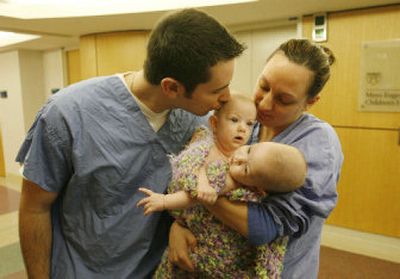
ROCHESTER, Minn. – After Mayo Clinic surgeons took nearly seven hours to untangle their livers, reposition their hearts and divide a shared intestine, 5-month-old twins born joined at the chest and abdomen were sleeping in separate beds Friday.
“We expect them to have a smooth night, but they are critically ill and we expect them to stay that way for the next 24 to 48 hours,” said Dr. Christopher Moir, the lead surgeon.
Abbigail and Isabelle Carlsen spent their first five months looking eye to eye, often bumping legs and arms and touching each other in the face.
That changed at 4:28 p.m. when the last tissue connecting the girls was cut, said Mayo Clinic spokesman Lee Aase.
“If any of you looked outside today, you noticed it was cloudy and rainy and the sun was nowhere to be seen,” said the girls’ father, Jesse Carlsen of Fargo, N.D. “I think that’s because it was in that operating room, with our girls and this team. And today all of our prayers have been answered, and I can’t thank you enough for helping our girls.”
The girls’ livers were intertwined and they also were joined at the diaphragm and the pancreas, and shared part of an intestine.
Doctors also removed both of the girls’ gall bladders during the procedure, so the drainage systems in the organs could be rerouted, Aase said.
Isabelle retained the common bile duct, and doctors constructed a biliary structure for Abbigail.
“It was possible that they would not have enough intestine to lead a normal life,” Moir said. But doctors found enough and divided it evenly between the girls.
Doctors said that the surgery was complicated but that there was a 90 percent to 95 percent chance that both girls would survive.
Conjoined twins occur once in every 70,000 to 100,000 live births, according to the John Hopkins Children Center. Since the mid-1990s, there have been about 250 surgical separations in which one or both twins survived, according to the American Pediatric Surgical Association.