
Botched bridge called a learning experience
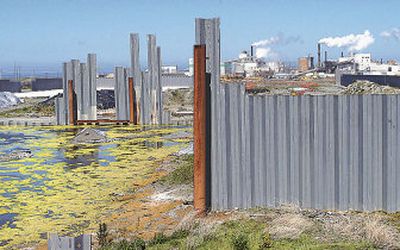

OLYMPIA – Washington released a warts-and-all report on an $87 million blunder – trying to build a Hood Canal Bridge construction yard on an Olympic Peninsula site that turned out to be a 1,700-year-old Indian village and a tribal burial ground.
State Transportation Secretary Doug MacDonald, who released the detailed, 224-page internal review, called the project a “nightmare” and “a very expensive misadventure” but said the state will learn from the experience.
The site was shut down in late 2004 at the Lower Elwha Klallam Tribe’s insistence after hundreds of ancient remains and thousands of artifacts were found as the site of the Tse-whit-zen village was unearthed. The waterfront village, at present-day Port Angeles, was leveled in the 1920s to make way for a sawmill.
Tribal and state archaeologists say the Indian village is the largest ever discovered in the state.
Choosing and then abandoning the Port Angeles site added nearly $87 million to the soaring price tag for replacing the eastern half of the floating bridge that links the Olympic Peninsula with the Kitsap Peninsula and the Seattle mainland beyond.
The new total is more than $470 million.
The scenic bridge is called the world’s longest floating bridge over salt water, at 1 1/2 miles long. It was opened to traffic 45 years ago, replacing a ferry run.
The detour through the Port Angeles “graving dock” experience added three years to the project. Rather than opening next summer, the rebuilt span isn’t expected to open until summer 2010. It’s currently open for traffic, but engineers fear it could sink in a storm, as the west half did in 1979.
In making the internal review public at a meeting of the state Transportation Commission, MacDonald and officials of the Department of Transportation weren’t apologetic or defensive.
MacDonald treated it as a cautionary tale about doing better due diligence when projects are planned in areas with known Native American sites. He essentially said there was blame to go around – and few rules to help decision-makers.
The Legislature, including members highly critical of the state’s handling of the project, ordered an independent audit. It will be released in a few weeks.
MacDonald was recently reappointed by Gov. Chris Gregoire, who requested the internal review of the bridge project. She was out of the country and unavailable for comment on Tuesday.
A tribal delegation attended the meeting but had no comment. The delegation’s attorney noted that the tribe and state are in mediation over follow-up issues and would honor a “gag order” on the parties.
Tribal Chairwoman Frances Charles gave commissioners calendars with photographs of some of the artifacts unearthed in the dig.
The commission was gentle with MacDonald and the agency, praising the director for his frank appraisal.
“They put everything in there, the good, the bad and the ugly,” said Commissioner Ed Barnes of Vancouver, Wash.
He and other commissioners said the state can’t stop building roads and bridges because of archaeological or cultural concerns, but it must improve its front-end studies and negotiations with tribes.
MacDonald said a number of projects, including the Grand Coulee Dam, resulted in the flooding or relocation of some gravesites, and that it’s a difficult problem that must be addressed. Finding graves does not necessarily doom a project, he said, quickly adding that he wasn’t talking about burial grounds the size of the one in Port Angeles.
“This story is not finished,” he said.
MacDonald’s long oral presentation and the thick report included an extensive narrative. He said critics may have their own take, but he wanted to release the whole chronology and the e-mails, newspaper accounts and other materials to help give the full story.
When lawmakers voted to finance the bridge project, contractors needed a place to build the concrete pontoons and anchors. State and federal fisheries agencies warned that it would be impossible or at least expensive to use the Concrete Tech facility in Tacoma, so the state looked elsewhere for a site.
Port Angeles gave the project a warm welcome, and the 22-acre port site could also accommodate pontoon work for a new Lake Washington 520 bridge, MacDonald said. The Lower Elwha Klallam Tribe also welcomed the project, he said. Neither the tribe nor the state’s archaeology consultant raised warnings about problems with the site, the report said repeatedly.
The project contract was awarded in August 2003, and excavation was halted shortly after tribal materials were found. Under terms of the “inadvertent discovery” procedures of the National Historic Preservation Act, the site was investigated, and all of the parties, including the tribe, agreed in mid-March 2004 to resume work.
In a cover letter to the report that MacDonald described as mostly his work, he said the parties “almost astonishingly” still didn’t have a full picture about the site.
“The graving dock story would have had a much different outcome if the second assessment had brought more materials to light” or if the experts or anyone else had “raised a more forceful alert,” MacDonald wrote.
Only after work resumed did the full scope of the problem become clearer. So far, the tribe says, the full remains of 335 Klallam forebears have been found, along with about 13,000 artifacts.
At the tribe’s insistence, the state pulled the plug in December 2004.
Some 493 days later, the first concrete was poured for one of the new pontoons – at the initially dismissed Concrete Tech facility in Tacoma.