
Straw bale home on the range

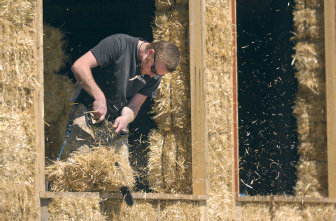
BILLINGS – Tara and Jerry Wolf’s straw bale home dispels one key notion. Building with straw doesn’t mean you have to stay small.
“You can be Earth-friendly and still have your dream home,” Tara said, looking up at the family’s chalet-style home under construction near Billings. “We wanted people to realize a straw bale house doesn’t have to be 600 square feet. It can be as big as you want.”
And the Wolfs are going big: 8,000 square feet on three levels. Five bedrooms, 4 1/2 baths and a huge game room and great room. And, it’s all off the grid.
“We’re doing it kind of over the top,” Tara said with a laugh.
But don’t get the wrong idea, the spacious home is more than rustic upper crust. Tara said her goal is “an organic feel.”
With sand from the Yellowstone valley, timbers from the hills of central Montana and straw from the irrigated wheat fields of a Denton ranch, they have certainly hit that target.
Building with straw was Tara’s idea, said Jerry, a local contractor. But it didn’t take much to win him over. His company, Millennium Homes, now specializes in timber frame and straw bale construction. She’s a real estate agent with Rimrock Realty.
“I figured, we’re surrounded by wheat fields,” Tara said. “So, we can be a little Earth-friendly.”
There are two distinct techniques for straw home construction. The more traditional type – the Nebraska-style straw home – is reminiscent of the homes that dotted the prairies a century ago. However, because the bales in that type of construction are used to create weight-bearing walls, the homes are limited in size.
The “hybrid” straw home, which the Wolfs are building, incorporates straw into a frame house. Because they don’t have to worry about bales sagging, the sky’s the limit on size.
“The straw bales are not structural,” he said. “They’re just fill for insulation purposes.”
And insulate they do. Jerry says the 16-inch-thick bales – finished both on the interior and exterior with an earthen plaster or “stucco” – provide an insulation value that ranges between R-50 and R-60, compared with the R-19 that is required by code.
The Wolfs, however, are banking on more than just straw. Passive solar and solar panels are incorporated into their home. The couple carefully positioned the house to get the maximum benefit from the sun, which washes in through a wall of windows on the south side. “It took some homework,” Jerry said, “and a lot of plotting.”
Down at the “power house” – a small straw-construction building that served as a test run for the main house – solar panels on the roof charge a bank of 32 6-volt batteries that provide most of the Wolfs’ electrical needs.
“On nice days, during the day, it’ll run everything we need,” Jerry said. “But when the inverter senses too much electricity has been used or there’s not enough (sun)light, the diesel generator will automatically kick on.”
When all’s said and done, Tara expects their 8,000-square-foot house will come in under $300,000.
“But if we were to build it for someone else,” she said, “it’d be more like the cost of a custom log home – about $250 per square foot.”
Do the math: that calculates into a $2 million house.