
Up America’s Highest
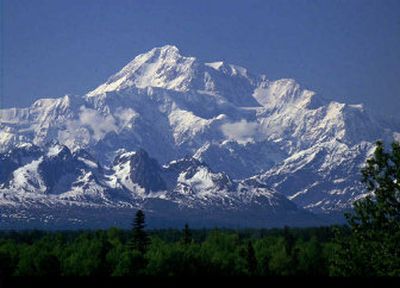
A steady stream of mountaineers is headed to Mount McKinley in Alaska to tackle North America’s tallest mountain.
Four climbing teams were waiting at 8 a.m. on May 1 — the unofficial start of the summer climbing season — for the doors to open at the Talkeetna ranger station, eager to check in and head up the 20,320-foot mountain.
“It is like the salmon,” Roger Robinson, lead mountaineer at Denali National Park and Preserve, said on May 2 as another van of climbers pulled into the parking lot. “They are arriving in a good number now.”
Greg Collins, a 42-year-old guide with the Alaska Mountaineering School, was waiting at Talkeetna Air Taxi for the clouds to clear to fly four clients from Alaska, New Jersey, New York and Illinois onto the mountain.
Collins has reached the summit 10 times.
“It’s incredibly challenging,” Collins said. “There are many hazards, but you get pretty good at it if you go there all the time… It makes you feel so alive.”
Park officials expect about 1,200 climbers to attempt McKinley this summer.
Most will choose the less technical West Buttress route to the top. Collins’ group is going up the West Rib route, a steep ascent that provides a direct route to the summit but requires climbing up short sections of 60-degree ice.
Climbers call one particularly scary stretch the “valley of death,” Collins said.
“I don’t know why they call it the valley of death,” he quipped. “There’s just a few meters of death.”
While McKinley is not considered the most difficult of the big mountains to climb, it is treacherous, mostly because the weather can become deadly in a heartbeat. Robinson points to three Japanese climbers whose bodies were found in 1989.
“At some point, they were blown down and across the surface, just blown away,” he said. “The only reason we found them is that the rope had snagged on some ice. The autopsy showed they were flash-frozen.”
Just one day after the climbing season opened, 83 climbers were already were on the mountain, said Maureen McLaughlin, park spokeswoman.
Last year, a record 1,340 climbers attempted McKinley with 58 percent from the United States. The other climbers were from 37 countries, with Canada, Japan, Spain and the United Kingdom leading the way.
The peak climbing period is from late May to early June.
“We can have just over 600 on the mountain at any given time in late May to June,” McLaughlin said. Last year, 101 climbers reached the summit on June 15. “That was pretty amazing,” she said.
On average, 52 percent make it to the top. Last year, the average was 58 percent.
Twin brothers from Ohio were among them, but fell to their deaths on the way down at a particularly treacherous traverse between 17,200 feet and 18,300 feet. Their deaths were the only ones in 2005.
“If you are tired on this traverse going back down, and it is pretty icy, it is the kind of ground if you start to slide it is really hard to stop,” Robinson said.
Measures were taken a couple of years ago to make that part of the mountain safer, Robinson said. T-shaped pickets were driven into the mountain. The pickets have holes in them, with webbing and carabiners attached. The anchors are about 100-150 feet apart.
“Climbers can clip into those as they go up and down,” Robinson said. “If someone slips theoretically this anchor should hold them.”
It probably would have saved 55-year-old brothers Jerry and Terry Humphrey of Negley, Ohio, but they left their rope back at their snow cave, Robinson said. It looked like they decided at the last minute not to bring it, he said.
The twins were the 94th and 95th people to die on McKinley since 1932 when the first deaths occurred.
Nonguided climbing teams and individual climbers are required to register 60 days before their climbs. A fee of $200 per climber is required.
Park rangers require basic information on climbers, including emergency contact numbers and their personal climbing histories.
Teams and individuals are not turned away because they look weak on paper, McLaughlin said. But rangers may encourage climbers to try easier climbs first or use a guide.
Climbers start by flying 50 air miles from Talkeetna into base camp at 7,200 feet on the Kahiltna Glacier. From there, climbers using the most popular route usually go to 7,800 feet, where they stop and camp in a flat area before starting up a gentle slope.
Climbers proceed up the glacier until they reach 11,000 feet, where rangers advise them to take a couple of days to acclimate to higher elevations.
From there, they head to Windy Corner at 13,000 feet — not a good place to stop — and on to the upper base camp at 14,200 feet. The Japanese climbers have a name for this spot where up to 200 people a night camp. They call it McKinley City, Robinson said.
“People are coming in and out all the time, at all hours,” he said.
The serious climbing begins from this point on, said Robinson, who has climbed the upper reaches of McKinley numerous times.
Climbers use fixed lines to scale a steep rock and ice ridge to 16,200 feet. The mountain’s high camp is another 1,000 feet on a shelf off the side of the mountain.
“Generally, people don’t spend a lot of time there,” Robinson said.
The next section, the Denali Pass traverse from 17,200-18,300 feet, is where the Ohio brothers died.
After walking across a basin, climbers at 20,120 feet are confronted with the summit ridge, the last 200 feet to the actual top of the mountain. The drop-off from the ridge is two miles on one side, 500 feet on the other.
At that point, some climbers decide they’ve gone far enough, Robinson said.
“For a lot of the year, it is real hard ice. It would scare the typical person half to death to be there,” Robinson said. “They say, ‘That is good enough for me.’ “