
Report doubts levees ready

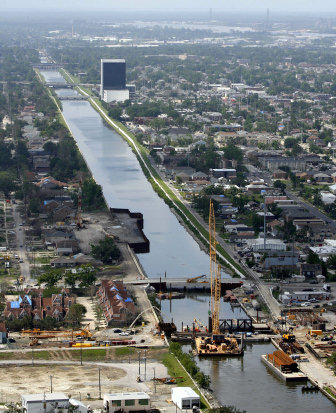
A wide range of design and construction defects in levees around New Orleans raise serious doubts that the system can withstand the pounding of another hurricane the size of Katrina, even after $3.1 billion of repairs are completed, a team of independent investigators led by the University of California, Berkeley’s civil engineering school said Sunday.
The findings undermine assurances by the Bush administration and the Army Corps of Engineers that the federal levee repair program due to be completed in June will provide a higher level of protection to New Orleans, which sustained 1,293 deaths and property losses of more than $100 billon from Katrina.
The team’s 600-page report disputed most of the corps’ preliminary findings about what caused levee breaches, saying the Corps’ investigators had made critical errors in their analysis.
The mistakes raise concerns about whether the corps is competent to oversee public safety projects across the nation, said Raymond Seed, a UC Berkeley civil engineering professor who led the investigation, which the National Science Foundation sponsored shortly after Katrina struck.
“People think this is a New Orleans problem,” Seed said. “It is a national issue.”
The Berkeley team found that the defects that caused breaches during Katrina – including thin layers of soil with the consistency of jelly and sections of levees built with crushed sea shells – had gone undetected and could be widespread.
“The rest of the system is unproven,” Seed said. “The entire system needs a serious re-evaluation and study.”
In addition, the team’s report makes 11 major recommendations, such as creating a national flood defense authority and increasing the corps’ technical strengths.
In particularly tough comments, Seed said the corps formal investigation so far has missed critical evidence and reached incorrect conclusions.
The corps “is conducting the most important engineering analysis in its history” in determining why storm walls and levees around New Orleans failed last August, Seed said.
“And they got it wrong. When the entire world is watching and a city has been destroyed, you want to get it right.”
A spokesman for the corps said that it could not comment on specific findings until it had a chance to examine the Berkeley report, but that the agency stands by the New Orleans levees and the work of its investigators.
“I don’t think there is any question that it will be a better levee system than before Katrina hit,” said Gene Pawlik, a spokesman at the corps’ headquarters. “We have had folks walk every inch of those levees.”
Pawlik added that the agency had “huge confidence” in the team of 150 investigators, who are backed by such resources as supercomputers and centrifuges.
The corps is conducting the official government investigation into the levee failures through a group called its “interagency performance evaluation task force.” It is expected to deliver a 7,000 page report June 1, though it has disclosed many of its key findings so far in preliminary reports and statements. The corps’ investigation is to be reviewed by the American Society of Civil Engineers and the National Research Council.
In a written statement, Ed Link, the head of the task force, said he was “delighted to get any additional input from thoughtful teams and looks forward to being able to review what they have done.”
The Berkeley-led team has three dozen researchers, including experts from seven other universities and several private corporations. Berkeley is widely regarded among the top civil engineering schools in the world. Its work was assisted by experts at Texas A&M University and the University of Missouri-Rolla.
The group looked at the corps’ internal culture and resources, asserting that its technical competence had been eroding since the 1970s in response to pressure by Congress to streamline its organization and reduce the cost of its projects.
Robert Bea, a Berkeley engineering professor who began his career at the corps and is a member of the National Academy of Engineering, said the corps had failed to recognize early warning signs that might have alerted it to problems in the levee system before Katrina.
Responsibility for the failures extend well beyond the corps and include many levee boards and other local political organizations, Bea said. That system made a series of compromises that resulted in substandard design and marginal quality, in exchange for lower costs.
“A culture of safety was replaced by a culture of efficiency,” said J. David Rogers, a geological engineering professor from the University of Missouri-Rolla.