
Bush hails new Iraq government
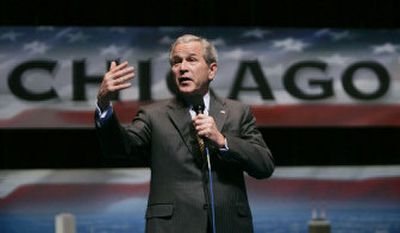
CHICAGO – President Bush on Monday hailed the formation of a new Iraqi government as a “turning point” that will allow U.S. forces to take an “increasingly supporting role” against insurgents as Washington and London look for ways to disengage from the war.
Acknowledging the “unease” felt by many Americans, Bush said the war in Iraq has proved “more difficult” than expected and produced only incremental progress. But he said the first government formed under the new, democratic Iraqi constitution would take on more of the burden.
“We can expect the violence to continue, but something fundamental changed this weekend,” Bush said in a speech to the National Restaurant Association. “The terrorists are now fighting a free and constitutional government. They’re at war with the people of Iraq. And the Iraqi people are determined to defeat this enemy, and so are Iraq’s new leaders and so is the United States of America.”
Bush did not say when the shift to a supporting role would permit U.S. troops to come home, but British Prime Minister Tony Blair made a surprise visit to Baghdad on Monday and announced he would fly to Washington to consult with the president Thursday and Friday about the next steps. The British have drawn down their forces by about 10 percent in the last two months, and officials have said they hope to make “good progress” toward a hand-over in the next year.
Bush has set a goal of turning most of Iraq over to Iraqi security forces by the end of the year, a target repeated Monday by newly installed Prime Minister Nouri al-Maliki. But U.S. and British officials dismissed a London newspaper report that Bush and Blair plan to announce a specific drawdown of forces in Iraq.
A British Defense Ministry spokeswoman called it “speculative” and said “we will draw down when conditions for the hand-over are met.” A senior U.S. official told reporters not to expect a “fixed number” of cuts to emerge from the Bush-Blair meeting.
Some Democrats insisted they should set a concrete plan for withdrawal. “Our soldiers have done their job,” said Sen. John F. Kerry, D-Mass., the party’s 2004 presidential nominee. “Now it’s time for the Iraqis to do theirs. We must immediately begin working with the new Iraqi government on a schedule for withdrawing American combat forces by the end of this year.”
Pentagon authorities have spoken for months of plans to reduce U.S. forces in Iraq by 30,000 by the end of the year, which would bring the total number of American troops in the country to about 100,000. Britain has been downscaling its presence from 8,000 and should have 7,200 left in a week or so. But both governments have rejected firm timetables and said reductions will depend on improvements in security.
Citing the formation of the new cabinet and al-Maliki’s emphasis on tackling problems of security, corruption and basic services, the senior U.S. official said that some conditions in Iraq “are moving in the right direction.” At the same time, the official sought to lower expectations about the new government’s ability to quickly curb ethnic militias behind much of the violence.
“I would not expect to see an immediate decrease in the violence,” said the official, who briefed on condition of anonymity. “If you look at the pattern of violence over the past few years, there’s generally been an uptick in violence after significant political events.”
In his speech here, Bush tried to balance optimism with concessions of mistakes. “Yet we have now reached a turning point in the struggle between freedom and terror,” he said. He noted that the new Iraqi parliament speaker, Mahmoud al-Mashhadani, a Sunni Arab, once opposed the U.S. military presence. “He wouldn’t have taken my phone call a year ago,” Bush said. “He’s now taken it twice.” He added, “As the new Iraqi government grows in confidence and capability, America will play an increasingly supportive role.”
During a question-and-answer session following his speech, Bush was asked about public disconnect from the government. “I would say that there’s an unease in America now,” he said, “and the reason why is because we’re at war. And war is more difficult. … Our progress is incremental. Freedom is moving, but it’s in incremental steps. And the enemy’s progress is almost instant on their TV screen.”