
The Collector
Dear Collector,
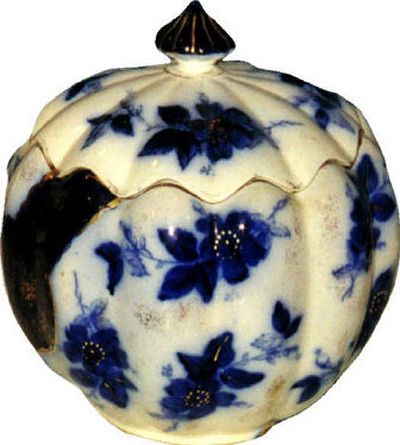
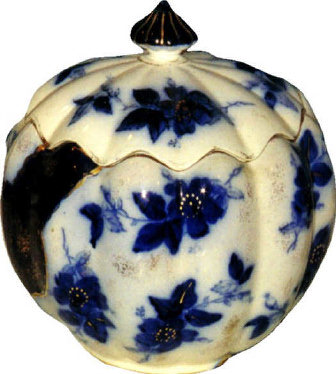
This piece was my grandmother’s, who was born in Scotland. Marks on the bottom are difficult to read: “A?M?” and “SM & Sons.” I would appreciate any information you can give me, including value.
A little Holmesian sleuthing (and rearranging of letters) proves your circa 1890s flow blue covered bowl was made in the Stoke-on-Trent pottery of Sampson Hancock & Sons. Value is a bit more difficult to determine, but let’s call it between $75 and $125.
Dear Collector,
My husband would like to know what his series 1929 $20 bill is worth.
No creases, no tears, no pinholes means that his very fine National Bank Note is worth more than $100, perhaps as high as $150.
Dear Collector,
Would the radio in these pictures be of any value? It still works.
A product of Firestone (the tire people), your 1940s Model 4-A-61, nicknamed “Cameo,” has a current value of about $50.
Dear Collector,
I am terribly interested in knowing how old these bookends are. You don’t have to tell me what they’re worth.
Easy enough task: Your metal Shakespeare bookends date from 1925 and were made by Nuart of New York.
Dear Collector,
My father bought this Waterbury clock new many, many years ago. Can you pinpoint when it was made, and value, if any?
Your circa 1918 wall-mounted regulator (named after Arion, a mythological musician), has a potential value of $300.
Dear Collector,
Is this old-fashioned cigarette lighter worth anything? I got it years ago when items like this were thought rubbish.
Sometimes described as a trench lighter due to its popularity during World War I, this example from Novitas in durable brass is valued at $50 to $70.
Dear Collector,
I know you wrote a book on mustache cups and hope you can identify the maker of the one in the enclosed pictures. Any help would be greatly appreciated, as this cup belonged to one of my distant relatives.
There are several problems with your “mustache” cup: It’s really a shaving scuttle (a large type of partitioned mug with a perforated area to drain the brush) that came from an unknown 1930s Japanese porcelain maker.
Dear Collector,
How much would this antique Australian penny be worth right now?
Australia’s first mint was established at Sydney in 1855 to produce coins from a local gold strike; and though minted in 1911, your bronze coin misses qualifying as an antique by a few years (law and custom require antiques to be at least 100 years old). Based on the decimal system, as is ours, Australian currency’s lowest denomination is now the one-cent coin, though in earlier days there was the half-penny piece. Maximum value on a near perfect penny is only a dollar – American, of course.
Dear Collector,
I have a #29 Donald Duck comic book in pretty good shape.
The snapshot you sent along, though fuzzy, shows this 1953 Dell book to be in less than great shape, with a large crease on the cover. With damage done, utmost value is still less than $10.