
Bush backs Israel if border talks fail with Palestinians
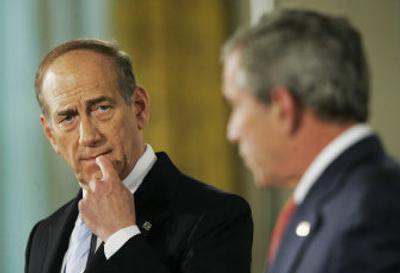
WASHINGTON – President Bush expressed support Tuesday for a plan that would let Israel draw borders for itself and a Palestinian state if Middle East peace talks remain stalled.
While Bush said he favors a negotiated settlement, as every president since Harry Truman has, his comments after a White House meeting with Israeli Prime Minister Ehud Olmert effectively cleared the way for Israel to dictate a solution if Israelis and Palestinians can’t agree on the outlines of a new Palestinian state.
Olmert pledged to “make a genuine effort to negotiate” but said he wants to settle the issue one way or another in three or four years. He said he intends to come up with a plan that “guarantees Israel’s security as a Jewish state with the borders it desires.”
“Despite our sincere desire for negotiations, we cannot wait indefinitely for the Palestinians to change,” Olmert said, with Bush by his side. “If we come to the conclusion that no progress is possible, we will be compelled to try a different route.”
The election in January of a Palestinian government dominated by Hamas, a militant Islamic group dedicated to Israel’s destruction, all but extinguished hopes for meaningful peace talks anytime soon. Bush and Olmert agreed that the best option at this point is for Israel to reach out to Palestinian Authority President Mahmoud Abbas, a relative moderate and secularist who says he opposes terrorism and accepts Israel’s right to exist.
Olmert has made no secret of his low expectations for success, given Abbas’ limited influence in the Hamas-dominated government.
Olmert took a slightly different tone at the White House by carefully distinguishing between Abbas and Hamas leaders. He said he plans to meet with Abbas “in the near future.”
Bush also seemed skeptical about the prospects for peace talks, even as he urged Olmert to pursue them. Jordan’s King Abdullah and other Arab leaders have pressed the administration to support Abbas.
“How can you have two states side by side in peace if one of the partners does not recognize the other state’s right to exist?” Bush said.
He called Olmert’s fallback plan – a unilateral Israeli withdrawal from parts of the West Bank – a bold idea “that could be an important step toward the peace we both support.”
Olmert presented his ideas to Bush on his first visit to the White House since the Israeli leader took over in March from stroke-disabled Ariel Sharon. Both men seemed eager to forge the kind of close relationship that Bush and Sharon shared.
Bush repeated his intention to protect Israel in any confrontation with Iran.
“In the event of any attack on Israel, the United States will come to Israel’s aid,” Bush said.