
Cannes festival wraps with top honors
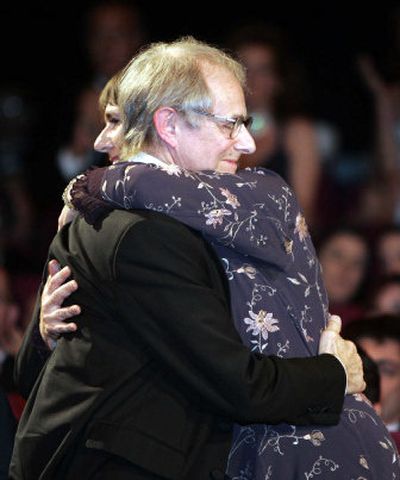

CANNES, France – Competing with several films grappling with colonial rule and the ravages of battle, a film about guerrilla warfare, early 20th century Irish-style, won the top prize at this year’s Cannes film festival Sunday.
Nominated seven previous times for the top Cannes prize, the Palme d’Or, British director Ken Loach won for “The Wind That Shakes the Barley,” screenwriter Paul Laverty’s account of a doctor caught up in Ireland’s fight for independence in the early 1920s.
Accepting the award onstage at the main Palais exhibition hall, the Lumiere, Loach called his film “a little step, a very little step, in the British confronting their imperialist history.”
“Maybe if we tell the truth about the past … we tell the truth about the present.”
The second-place Grand Prix prize went to French director Bruno Dumont’s “Flandres,” a stark modern-day fable of love and war, juxtaposing scenes of provincial farm life with an unspecified Middle Eastern conflict. Judging from its reception at the Lumiere, this award may prove to be one of the more hotly contested from this year’s Cannes.
Jury president and Chinese filmmaker Wong Kar Wai acknowledged that he and his eight fellow jurors, including actors Samuel L. Jackson, Tim Roth and Helena Bonham Carter, deliberated the longest for their choice in the third-place Jury Prize selection. For that prize Wong and company chose Andrea Arnold’s first feature, the riveting psychological drama “Red Road.”
Beloved Spanish auteur Pedro Almodovar’s “Volver” came away with two prizes Sunday. His film’s six principal female performers, led by Penelope Cruz and Carmen Maura, received a group citation for “Prix D’Interpretation Feminine,” or best actress.
Almodovar also won best screenplay for his story of mothers and daughters and the secrets they keep.
Prior to Sunday’s awards ceremony, the Chinese picture “Luxury Car,” took home first prize in the secondary Cannes competition known as Un Certain Regard.
The jury showed only un certain contempt for a weak field of American entries, most notably and controversially the Sofia Coppola costume epic “Marie Antoinette.”
Twenty films played in the main competition for this year’s 59th annual festival, with 24 competing for Un Certain Regard, whose jury was headed this year by maverick American filmmaker Monte Hellman.
Sunday night, jury members spoke of their frustration regarding films they admired that went home empty-handed. Roth praised the Chinese film “Summer Palace” and “Marie Antoinette.” Fellow juror and Palestinian director Elia Suleiman championed the Portuguese drama “Juventude Em Marcha,” or “Colossal Youth,” a film whose exquisite and measured sense of composition managed to clear one screening of at least 200 people.
Suleiman noted that while films such as “The Wind That Shakes the Barley” address political injustices of the past, “a lot of them are actually dealing with the issues of the world today, and I don’t think it’s an accident. We are living in a troubled global atmosphere.”