
Traffic prosecutor planned
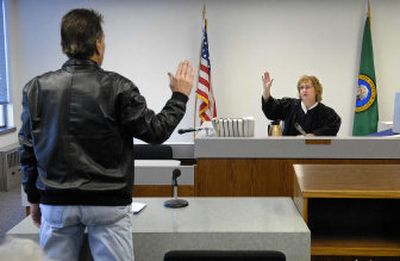
Drivers who get ticketed for speeding or running red lights in the city of Spokane have had a one-way street in court in recent years.
The city routinely has failed to send a prosecutor to argue in favor of citations issued by police. As a result, drivers who challenge their tickets in non-criminal, non-accident cases have been able to tell their versions of events without anyone to challenge them.
Spokane Mayor Dennis Hession said he wants to change that. He has approved a budget recommendation that would add one prosecutor to the city’s staff for handling contested traffic infractions.
“It’s important we not only issue tickets, but we have a reputation for enforcing them,” Hession said on Wednesday.
The result has been a loss of about $200,000 in fines to the city and state annually. More importantly, officials said, the practice sends the wrong message to errant drivers – that the city doesn’t take traffic infractions seriously.
On Wednesday, for example, Drew Backlund, of Spokane, told Court Commissioner Virginia Rockwood that he was not driving too fast for conditions last summer as alleged by a police officer on a ticket submitted to court. Backlund said he was taking his father to the airport in his Ford muscle car but did not cause his tires to spin when accelerating from the intersection of 29th Avenue and Grand Boulevard.
“I did not create or cause an infraction,” Backlund said. “I’m not a bad person. I’m a good person.”
Rockwood found in his favor and quashed the $101 citation.
Prosecutor Howard Delaney estimated that the city loses about $90,000 a year in revenue from tickets that are overturned by judges because the city does not send a prosecutor to court, even though a prosecutor would cost the city only about $60,000 a year, leaving about $30,000 a year in extra money for the city’s general fund.
“It’s been a little frustrating to us over time,” Delaney said.
A request last year to add another prosecutor for traffic court in 2006 was rejected by former Mayor Jim West and the City Council, even though the prosecutor’s office argued in favor of adding the prosecutor.
Hession, who sat on the council during last year’s budget deliberations, said he was convinced that the added prosecutor is needed for public safety.
“It would be helpful,” Rockwood said of adding a prosecutor to contested traffic court sessions. The prosecutor would be able to assemble driver records, coordinate reports to lawyers, make recommendations on cases and arrange appearances by police officers in some cases, she said.
Drivers who appear in court on traffic tickets are given the chance to tell their version of events. A signed ticket issued by a police officer is considered sufficient evidence for a judge to find that the driver committed the violation. However, the judge must consider the driver’s testimony and may find that the violation was not committed, or send the case for a hearing on a possible reduced fine.
Delaney said that without a prosecutor to cross-examine the driver, the judge may not hear facts that favor the city’s side. He said it’s a matter of making sure drivers are held accountable.
“If people are held accountable, they are less likely to do it again,” Delaney said.
The tickets involve fines that start at $101 for violations such as speeding less than 10 miles above the posted speed or running a red light. They can be as high as $538 for second-degree negligent driving, failure to have automobile insurance or driving with an expired license, but with identification.
Robert Benn, of Spokane, who appeared before Rockwood on Wednesday, said he believes the traffic court is simply a money-maker. He was facing nearly $1,300 in fines for a series of violations. Rockwood reduced the total to $767.
“As far as I’m concerned,” Benn said in an interview, “the whole thing here is about earning revenue.”