
An iconic trail
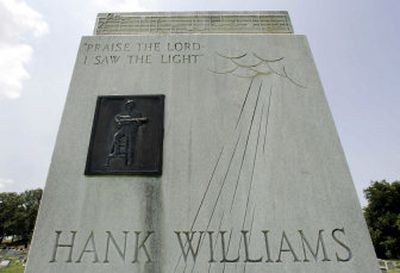
MONTGOMERY, Ala. – More than half a century after his death, fans are still paying homage to country music icon Hank Williams.
His boyhood home, a museum in Montgomery and the cemetery where he and his wife are buried attract a steady stream of fans, including visitors from England, Japan and other places around the world.
A new brochure lists these and other sites along what the Alabama Bureau of Tourism and Travel calls the “Hank Williams Trail.”
“I enjoy all country western music and Hank is one of the best,” said Guyla Hornsby, who visited Williams’ grave last summer with her husband, Preston. “I didn’t know what to expect, but it’s pretty neat.”
Williams’ driver found him dead at age 29 on Jan. 1, 1953, in the backseat of his Cadillac en route to a gig in Ohio. While the cause of death is still a subject of controversy, his short career had been marred by heavy drinking and use of painkillers for a back condition.
His hits included a dozen singles at No. 1 and many more in the country top 10. Among them were “Your Cheatin’ Heart,” “I’m So Lonesome I Could Cry,” “Cold, Cold Heart,” “Hey Good Lookin,’ ” “Jambalaya (On the Bayou),” “Move It On Over” and “Lovesick Blues.”
Williams is buried in the Oakwood Cemetery Annex, about a mile from the Hank Williams Museum in downtown Montgomery. The grave site features two white and gray marble monuments, one to Hank and one to his wife, Audrey. Marble slabs with their names and the years they were born and died mark the burial sites. There’s also a marble replica of Williams’ cowboy hat.
A low marble curb pens in the artificial grass-carpeted area around the monument, and two marble benches provide a resting spot.
While folks come year-round to pay their respects, ceremonies are held at the cemetery twice a year: on the Jan. 1 anniversary of Williams’ death, and on his Sept. 17 birthday.
The New Year’s Day event “is the best time of year to come,” says Lee Sentell, director of Alabama Tourism. Fans gather at the museum in downtown Montgomery, and singers, both professional and amateurs, perform impromptu renditions of his songs.
Guests at the events have included elderly members of Williams’ old band, the Drifting Cowboys, along with Charles Carr, the driver who found him dead.
More than 25,000 people came to Montgomery for Williams’ funeral, a record crowd for the city that has never been surpassed. The funeral was held in City Hall, which is also on the Hank Williams Trail, and broadcast to the crowds outside. A statue of Williams stands across the street.
The Hank Williams Museum gets about 35,000 visitors a year. The museum was founded in 1999 by Cecil Jackson, who fell in love with Williams’ music at age 8, before he had started recording. He was popular locally and Jackson heard him on the radio.
Jackson’s daughter, Beth Birtley, manages the museum today and describes herself as a lifelong fan.
“I’m very proud to have had my father teach me who Hank Williams was and how to appreciate him and his music,” she says. “And I’m proud to be a part of the family that helps keep his memory alive.”
Museum exhibits include the convertible Williams was riding in when he died.
Williams’ fans may also want to pay a visit to Lincoln Cemetery, where a 9-foot-tall white marble stone notes that his mentor, Rufus “Tee-Tot” Payne, is buried there. The exact location of his unmarked grave is not known. Payne, a black street musician, taught Williams to play guitar in the 1930s.
Sentell, the tourism director, says fans often make nocturnal visits to Williams’ grave in Oakwood, and they sometimes leave an unusual offering.
“Because of Alan Jackson’s song ‘Midnight in Montgomery,’ fans of William’s, as well as country music in general, will frequently go up there to have a beer,” Sentell says.
He says he went up to the grave one Sunday to take photos in the early morning light and found several empty beer cans, as well as a full one – seemingly left for Williams.
“Somebody, during the night,” he says, “shared a brew with Hank.”