
Gates seen as consensus builder
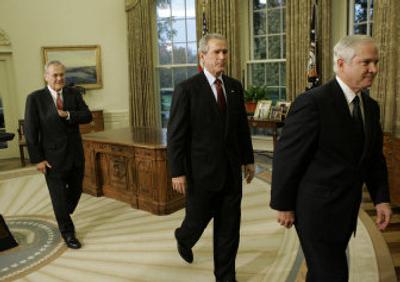
WASHINGTON – Robert Gates, the veteran intelligence official who is President Bush’s nominee to become the new secretary of defense, is widely viewed as a consensus builder who may break down barriers between civilian and military leaders – as well as between the Pentagon and other agencies – that grew legendary under Donald Rumsfeld.
Gates, 63, is a close associate of former President George H.W. Bush and was deputy national security adviser during the first Gulf War. He rose rapidly through CIA ranks as a Soviet expert with extensive White House experience to become director of central intelligence from 1991 to 1993.
A native Kansan with shrewd bureaucratic instincts, Gates lacks the top-down, take-no-prisoners managerial style that won Rumsfeld enemies and instead is more likely to set up task forces and maneuver to forge agreements behind the scenes, according to Gates’ associates. While Rumsfeld issues flurries of directives and memos nicknamed “snowflakes” in keeping with his business executive past, Gates is a listener who leads with the inherent circumspection of an intelligence analyst, they said.
“Rumsfeld’s a wrestler. Bob Gates likes to hike,” said Richard Haver, a former senior official who has worked closely with both men. “Gates is not about to get on a mat with someone and pin him. With Rumsfeld, pinning is the name of the game.”
At the Pentagon, senior military officers said that while Rumsfeld is perceived as arrogant and a fierce turf-battler, Gates is viewed as a far less combative and more conciliatory figure. “Gates has a track record of bipartisan support and being respected and accepted by … different parties,” said a senior Army general, adding, “I think he’ll be fine.”
Gates could help ease the tensions that arose as Rumsfeld moved to impose greater civilian control on the military services and military operations, active and retired military officers said.
Zbigniew Brzezinski, who was Gates’ boss as national security adviser in the Carter White House and today is one of the sharpest critics of the Iraq war, on Wednesday described the appointment as “the best … that President Bush has made in the course of his six years in office.” Brzezinski described Gates as someone “whose judgment can be trusted and whose common sense is reassuring,” and said that “this appointment may be marking the beginning of a major corrective in American policy towards the Middle East.”
Gates is a member of the Iraq Study Group, a congressionally mandated bipartisan commission headed by former Secretary of State James Baker and former Rep. Lee Hamilton, D-Ind. That group’s close review of the situation in Iraq over the past several weeks will give Gates momentum going into the new job, observers said. “Gates is going to have to move pretty fast. He doesn’t have a lot of time to study this,” said the retired four-star general.
Several associates stressed that Gates is a pragmatist and not an ideologue, and characterized him as being the same type of moderate Republican on foreign policy issues as Baker. A senior intelligence officer who has known Gates for 30 years described him as tough, brilliant and hard-working, but said Gates had sharp elbows for those who got in his way.
Gates, who holds a Ph.D. from Georgetown University, left government in 1993. He became president of Texas A&M University in 2002, a post he described Wednesday as the one he has enjoyed more than any other during his career.
“I had not anticipated returning to government service,” he said at a White House announcement ceremony flanked by Bush and Rumsfeld. But he said the United States is engaged in wars that “will shape our world for decades to come,” and with strategic interests at risk and “so many of America’s sons and daughters … in harm’s way, I did not hesitate when the president asked me to return to duty.”