
Colleges offer Nez Perce classes
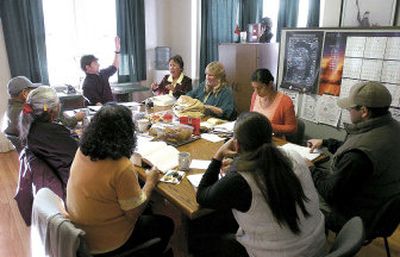
LAPWAI, Idaho – In a small white house, the elders and students crowd around the large square table that dominates the classroom. Hovering over hot cups of “lalx,” the Nez Perce word for coffee, the students take in stories relayed by tribal members of days gone by.
Students Thomas “Tatlo” Gregory and Maggie Picard don’t pick up every word, and admit to a bit of information overload after class.
These twice-weekly conversations are part of the advanced conversational Nez Perce language class offered by Lewis-Clark State College.
“It’s good for them to hear the language like this,” elder Bessie Scott said of the class. “The words are hard and it’s better if they hear the sounds. It helps them.”
Half Nez Perce, Gregory is trying to learn a language he remembers his grandmother speaking when he was young. He loves it.
“I never … really found any place in the culture,” Gregory said. “I started taking this class, I feel this is where I belong.”
The classes are taught by Harold Crook. He has been teaching the course since the fall of 1998, although it has been taught at Lewis-Clark since the 1970s. The language is the only offering besides Spanish that satisfies the college’s language requirements. Crook came to the Lewiston-Clarkston Valley after studying Nez Perce as part of a linguistics doctorate at UCLA.
He works for the college and the tribe. Crook also teaches at the Northwest Indian College’s distance learning center in Lapwai.
With fewer than 40 fluent speakers, a number declining every year, Crook said the language will eventually die if younger students don’t learn it.
“By preserving the whole language, by invigorating the language, you’re in essence saving the culture,” he said.
Beginning students are learning terms for food and weather in their class on the Lewis-Clark campus. That class is larger than the advanced conversation class, with about 18 students on the campuses of LCSC, the University of Idaho and Washington State University, all connected via video. The school also is trying to coordinate podcasts into the curriculum.
That’s a giant leap for a language that has had to come up with words that even elders didn’t speak growing up.
“We have to make up a lot of this that we didn’t have a long time ago,” said Verna Sonneck. “We didn’t have ‘water heater’ a long time ago.”
Sonneck, the tribe’s cultural resources director, is one of the elders who helps add to these conversations. Another is Cecil Carter, who converses in advanced Nez Perce and teaches alongside Crook in the beginning classes at Lewis-Clark.
“There are some words that are kept out of the dictionary, yet,” Carter said. “But most of them are in there.”
Carter has taught alongside Crook for almost 10 years. Carter sits in to help pronounce words in the language he has known his entire life.
“He’s really essential; the elders provide the authenticity for this language,” Crook said, referring to Carter as an encyclopedia of the language.
The 1,280-page Nez Perce dictionary contains words elders may not have used in years, making these twice-weekly conversations a learning experience for them, too.
As elder Bessie Scott explains, it is those conversations that keep the language alive.
“I grew up in a household that spoke the language all the time,” Scott said. “I never had to really converse in the language, but I heard it every day.”
Students can study the words all they want, but going to class and hearing the elders speak is a completely different experience.
“It links me to my culture and it links me to the past, because it’s part of who we are,” said Gregory. Picard’s children are Nez Perce, which gave her the initial idea to take the classes. She wants to learn the language so her children can carry it on.
“As a mother I feel I have to teach them,” Picard said. “This was one thing I felt I really wanted to do for their education.”
Jeannie Hodges teaches beginners of all ages in Orofino and Kamiah, and began herself as a Nez Perce language student at Lewis-Clark. She needed to take a language for her English major, and decided to pursue one that was tied to the area where she lived.
“To me, how many people have the opportunity to hear the first words ever spoken where they are living?” Hodges said. “To me that’s a pretty incredible opportunity.”
Fellow tribal instructor Angel Sabotta said they have been trying to teach the language through pictures, noting the language itself is a visual one.
“We don’t have any books like you do in French, we’re always developing materials,” Sabotta said.
So they sit around a table on Tuesday and Thursday afternoons, and through their combined efforts they are able to have discussions using words even the elders haven’t used in a long time.
“That’s what we’re working toward is conversation,” Crook said of the classes. By the third year, students are able to talk to their elders around the table in their tribal language, and Crook increasingly takes himself out of the picture.
One of his ultimate goals is for his students to teach to their children, and become certified Nez Perce teachers in their own right.
“We really need younger people to become fluent second-language speakers so they can teach the language,” said Crook, noting the youngest fluent speakers are in their 60s.
Crook recognizes the total immersion of the language for all students is a tall order.
Right now, English still plays a part in the class. He hopes to one day have immersion sessions that last longer than the afternoon conversational Nez Perce.
“If we can get to that point, I think we can do that,” Crook said. “I think we will have learned something incredible.”