
Wal-Mart looking for a little fashion sense
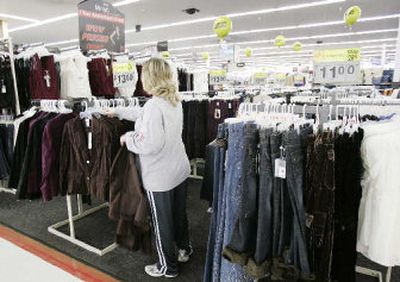
NEW YORK — This holiday season, a big challenge at Wal-Mart is convincing shoppers like Portia Goodman and Karen Wade to buy fashion instead of just basics.
“I buy more at Target than I do here,” said Goodman, a 31-year-old graduate student from Riverside, Ill., who was recently shopping for candy at a local Wal-Mart with her son. “I think they should be more like Target.” At Target, known for its cheap chic offerings, Goodman is attracted to apparel by designer Isaac Mizrahi and favors athletic gear by Champion.
As for Wade, a 47-year-old from LaGrange, Ill., she shops at Wal-Mart for “shirts and jeans because the price is good.”
Such reluctance from these consumers comes more than a year and a half after Wal-Mart Stores Inc. has worked hard to improve its image with new fashion brands, a trendspotting office in Manhattan, and fashion shows during New York’s Fashion Week. The company’s fashion faux pas, such as stocking up on too many trendy items like skinny jeans, was a big factor behind disappointing sales for September and October, and is expected to weigh down business in the critical fourth quarter, the company acknowledged late last month.
The upgrading of its fashion is part of the company’s larger campaign to expand into better quality, trendier merchandise to revitalize anemic sales and sluggish profit growth, a strategy that has gotten mixed grades from its customers so far.
Wal-Mart, which has built its reputation on selling basics like socks and detergent, made a push into $2,000 flat-screen TVs and other trendy electronics, 600-thread count sheets and organic foods. The goal is to pry more money from the hands of its wealthier customers, diversifying beyond its core-low income shoppers who are more vulnerable to economic downturns.
But while the company’s electronics business is “making progress,” organic foods and home furnishings have gotten mixed reactions, according to company’s CEO and president Lee Scott in a recent address to investors.
Fashion appears to be the most challenging. In fact, in a sign that Wal-Mart’s upscale strategy has fallen flat, the company dumped its two long-time ad agencies and hired Draft FCB late last month. Draft, a division of Interpublic Group of Cos. Inc., will develop future advertising to better attract both low-price fans and higher-income shoppers.
The company, which played down its low prices over the past year, is reemphasizing its rollback, or discount strategy this holiday season, with deep price cuts on toys and electronics. On Friday it extended the price cuts to home appliances. Wal-Mart’s “Be Bright” holiday campaign, produced by lame duck ad agency Bernstein-Rein Advertising Inc., focuses on value fashion.
Wal-Mart needs to win in apparel for several reasons. Shoppers are facing more fashion choices this holiday season from low to mid-price stores like Target Stores Inc. and from mid-price department stores like J.C. Penney Co. and Kohl’s Corp., both of which have developed more exclusive brands.
Apparel also offers fatter profit margins compared to electronics and food, according to Howard Davidowitz, chairman of Davidowitz & Associates, a New York-based retail consulting and investment banking firm.
But more importantly, fashion sets the tone for the entire store, said Robert Buchanan, retail analyst at A.G. Edwards & Sons
“Fashion tends to drive the train,” he said.
Wal-Mart has blamed its flawed fashion strategy on execution, such as overexpanding Metro 7, an apparel brand aimed at fashionistas. Metro 7 successfully launched in 500 stores in the fall of 2005, then stalled when it expanded to 1,500 stores this past spring. The company now says Metro 7’s distribution shouldn’t be in more than 900 stores.
Scott told investors that the company needs to better heed to a pyramid, where the bottom is basics such as underwear and socks, the middle is fashion basics and the top is trendy fashions like skinny jeans.
“We need to remember who we are and be able to fill that center part of this pyramid and then have a little bit up there at the top, just so our customers know that we have a sense of what’s happening out there in the world,” Scott said.