
Gonzaga Prep grad Egan wins National Book Award
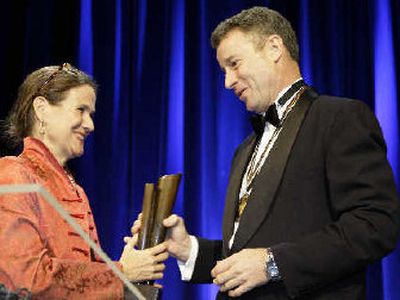

NEW YORK – Timothy Egan, a 1973 Gonzaga Prep grad, won the National Book Award for nonfiction Wednesday night for “The Worst Hard Time: The Untold Story of Those Who Survived the Great American Dust Bowl.”
“I feel like I just ran a sub-four-minute-mile,” said a giddy Egan, clutching his trophy while photographers gathered around him at the New York Marriott Marquis in Times Square. “The endorphins are kicking in.”
After Egan’s name was announced, the potential still existed for a Spokane-connected double win. Spokane’s Jess Walter was one of five finalists in the fiction category for his novel, “The Zero.” But when the fiction choice was announced a few minutes later, the winner was Richard Powers for “The Echo Maker.” Walter showed zero trace of disappointment.
“One of judges came up to me and said she loved how subversive my book was,” said Walter, in the banquet hall afterward. “That’s so great. I’m also really happy for Tim.”
Egan, in his speech, said that the story of the Dust Bowl had nearly died out because most of the survivors are in their 90s.
“Now, when they’re gone, the story will still live,” said Egan, who lives in Seattle and is a roaming national reporter for the New York Times.
One of the judges in the nonfiction category, Luis Urrea, said later that one of the arguments for Egan’s book was that “this is a book that will still be on the shelves in 50 years.”
“Every writer wants his words to live beyond him,” said Egan.
The National Book Awards are often called the Academy Awards for authors. This year, a total of 1,259 titles were nominated in four categories: fiction, nonfiction, poetry and young people’s literature. A panel of five judges in each discipline winnowed each category down to five finalists in October and then arrived at a consensus winner just before the black-tie Wednesday ceremony.
The winner for poetry was Nathaniel Mackey for “Splay Anthem.” The winner for young people’s literature was M.T. Anderson for “The Astonishing Life of Octavian Nothing, Vol. 1, The Pox Party.”
Both Walter and Egan previously said that being a finalist was an honor enough. As for the award itself, they both kept expectations low.
“It’s one of those day-dreamy moments you imagined your whole life,” said Walter, before the ceremony. “But I don’t know. I’ve exceeded my expectations already.”
Walter’s publisher, Judith Regan of Regan Books (a Harper Collins imprint), threw a luncheon for him at the posh Lever House restaurant in midtown Manhattan at noon on Wednesday.
Regan toasted Walter by saying that she first began to read his manuscript for “The Zero” while at a spa, “in my robe and all relaxed.” Page by page, she began to get more excited.
“I finally said, ‘Oh my God, I’m going to have to cancel my massage,’ ” she said. “I immediately called Jess and said, ‘You’re going to win the National Book Award.’ “
Close, but not quite.
Earlier, Walter correctly predicted that Powers, one of his favorite authors, would win in his category. Egan predicted a win in his category for “The Looming Tower: Al Qaeda and the Road to 9/11,” by Lawrence Wright.
After the announcement, Egan continued to express surprise that Wright did not win.
On the night before the ceremony, all 20 finalists (including those in the poetry and young people’s literature categories) gathered at the Tishman Auditorium at the New School in Greenwich Village for a sold-out reading. A finalist medal was draped around the neck of each author, in Olympic-like fashion.
“I plan to have mine embedded in my forehead,” joked Walter later.
The medals figured into a bit of comedy at the awards ceremony itself. Master of ceremonies Fran Lebowitz laughed at the fact that the finalists had all been sternly reminded to wear their medals to the ceremony.
“I think they all know that if they’re ever going to wear this medal, this is their only shot,” said Lebowitz, a writer and humorist. “They’re not going to be coming back into fashion.”
Yet one finalist did, in fact, forget to wear his medal. That’s why Tim Egan, at the high point of his writing career, rushed onstage wearing a borrowed medal.