
Low-visibility cells a concern

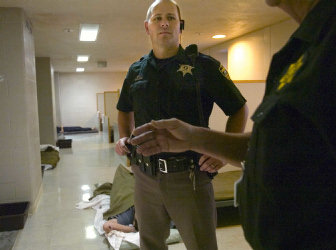
Some jail cells offer more privacy from the prying eyes of guards than others.
At the Spokane County Jail, those are the dormitory cells, large oblong rooms, some of which often house more than 10 people at a time.
It was in one of those dorm cells in 2004 that an inmate was beaten and strangled with a bed sheet. A year later a different inmate was sexually assaulted.
The cells have only small windows on the door and a wall. Spokane County Jail Commander Jerry Brady says that’s not enough.
“There’s a lot of blind spots in here,” Brady said while giving a tour of one of the cells this week. “Anytime you can have better eye contact with these people the safer the facility is.”
He is asking county commissioners to install large one-way windows into all of the jail’s 12 dormitory cells. Brady said the murder and assault are factors in making the request.
“I’m trying to make this a safer place,” Brady said. “The last thing in the world that I want is a phone call in the middle of the night that says, ‘Guess what?’ “
Jail officials say despite the big headlines from the murder, life in the dorms generally is peaceful. But they say installing the windows would help prevent a repeat of violence and deter bullying.
The cost of installing the windows, $750,000, might make the project unlikely in 2007. County Commissioner Mark Richard said he’s hesitant to spend money on the change at a time when budgets are being trimmed and officials already are contemplating a new jail.
The dorm cells no longer house inmates with violent histories like the ones who killed Christopher Rentz in October 2004. Still, even with low-security inmates in the cells, guards need better visibility, said Julian E. St. Marie, the attorney who is representing Rentz’s mother, sister and brother in a lawsuit against the county.
“I would say that would be money well spent,” St. Marie said.
Brady says the large price tag is the result of having to cut holes into walls designed to be virtually indestructible and then installing windows that can’t be tampered with.
On any given day, 100 or so of the Spokane County Jail’s inmates are housed in dorm cells, most of which accommodate about 10 inmates in beds and – when overcrowded – even more on the floors. Attached to the unit is a restroom with a shower, sink and toilets.
Inmates are allowed out for two and a half hours on weekdays and one and a half hours on weekends. Otherwise, a corrections deputy checks the cells once an hour, usually through the windows. There also is an emergency call button that can be pressed to reach a deputy.
When the jail first opened, it was designed for inmates to be out of their cells most of the day. But as it has become more crowded, inmates have been locked up for longer periods.
“When they were out all day, the windows were not that big of a deal,” said corrections deputy Robert Brittos, adding that he hopes any new jail is built without dorms.
A group of inmates serving time in the dorm cells this week had mixed feelings about living in the group setting. Some said they liked the larger space that allows them to move around, especially since the jail often is locked down because of overcrowding. Others, however, said it can be disconcerting, depending on the others they’re stuck with.
“When you’re in with a lot of people, how do you know who you’re in with?” said O’Neil Chisholm, adding that as an older inmate, he’s not as comfortable with younger ones and as a black man, he’s concerned about being locked in a room with racists.
The dynamics of a dorm cell can make work difficult for jail deputies. If vandalism or violence has occurred in a two-person cell, it’s pretty easy to determine who was responsible, Brady said. Not so in a dorm cell.
“We’ll get fights in the dorm cells and you’ll ask them and they’ll say, ‘I fell in the shower,’ ” Brady said. “They don’t want a snitch jacket to follow them wherever they’re going.”