
‘It turned into a habit’
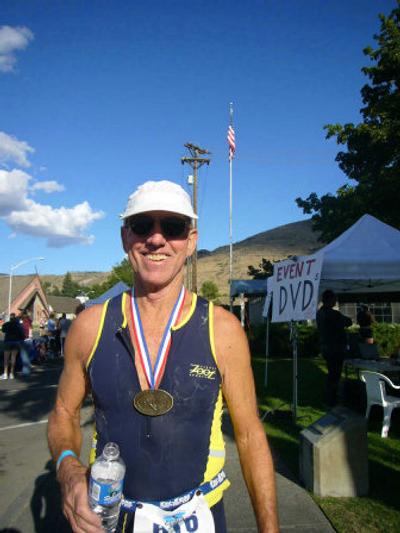

Most men look forward to retirement as a time to relax.
Ted Nichols looks forward to competing in full-length Ironman competitions.
Nichols, 63, regularly competes in half-Ironman triathlons and qualified for the ITU Long Distance Triathlon World Championships in Lorient, France, in July.
“I’m not entirely sure I’m going to go because it is an expensive proposition,” he said. “I qualified for the worlds last year, too. But they were held in Australia and that was really cost-prohibitive.
“I’ll make my decision by Dec. 1 whether or not I’ll go.”
Nichols, who lives at Newman Lake, grew tired of just running to keep in shape 13 years ago.
“I started at age 50. I was running and I was getting bored with it. A friend of mine was doing triathlons so I went to watch a couple of his races. I figured I could do that if I could just learn how to swim. I took up swimming, and fell in love with that and just kept on going.
“Once you do one race, you’re going to do more. It turned into a habit. You get addicted pretty quick.”
And he just keeps on improving. A year ago he shaved a full 15 minutes off his personal best time and did the same thing again this year.
“I would have to say that the run is my best of the three events,” Nichols said. “I’m an average swimmer at best. I’m right there in the middle of the pack; I’m not super fast, but I get through the water OK. On the bike, I’m right in the middle of the pack – maybe a little ahead of average.”
Triathlons come in varied distances. The Ironman, first run through the lava fields on the big island of Hawaii, is the longest in terms of distances: a 2.4-mile open water swim, a 112-mile bike ride and a marathon (26.2 mile) run.
A half Ironman, like the one in France, halves the distance of each individual leg.
Sprint triathlons are considerably shorter: a .75 kilometer (.45-mile) swim, a 22K (3.2-mile) bike ride and a 5K (3.1-mile) run. Olympic triathlons are a 1.5K (.9-mile) swim, a 40K (24-mile) bike ride and a 10K (6.2-mile) run.
Nichols started at the sprint level, then moved up to the Olympic distances. Six years ago, he jumped to the half Ironman.
“I had to try one,” he said. “Once I did one, I thought to myself, ‘Hey, this is really cool.’ “
There is nothing like the feeling of accomplishment after a race, he said. But the part that got him hooked was the camaraderie.
“The people you compete against are all just terrific,” he said. “You’re out there and you hear people encouraging one another. I think when you compete in something as exhausting as this, it brings people together. The only person, ultimately, that you compete against is yourself.”
Getting to the World Championships was no cakewalk.
“The race where I qualified was at Grand Coulee Dam, the Grand Columbian,” he said. “The run is all on packed gravel, which slowed me down. I’m much faster on pavement. If I did a half Ironman run on pavement, I know I’d have a much better time.
“And the bike leg there is pretty tough. Once you come out of the swim in Banks Lake, you take off and head up the Almira grade. It’s a climb up, out the canyon there, to get on top. It’s rolling hills up there, but once you get to Almira and turn around to come back, you’ve got 10 miles there on a 2-percent grade going up. That’s a long, hard pull going up hill that long and we had the wind in our faces that whole time.”
Nichols finished first in his age group, qualifying directly for the world championships in France.
If he decides to go, Nichols doesn’t plan on altering his training regime too much.
“I’ll probably keep my running pretty much where it is, but add a little more speed work. Swimming is, well, I just go out there and do my best.”