
Learning better fatherhood

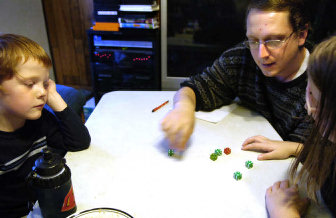
Tresa Torgersen, 9, isn’t shy in expressing how she feels about her father.
“He’s an awesome dad. He’s really nice and descriptive!” she said.
Her father, Lawrence Torgersen, grinned as he recently made oatmeal for Tresa’s 6-year-old brother, Devin.
For Torgersen, who is divorced, the road to “awesome dad” hasn’t been easy. He’s a legally blind single father, raising two kids while attending college full time.
He received help from a class called “Nurturing Fathers,” taught by Dan Wolfley, through SCAN (Spokane Child Abuse and Neglect Prevention Center). It’s the only fathering class in Spokane County with a non-faith-based curriculum that’s free and open to the public.
“I took the class because I wanted to be a better dad,” Torgersen said.
Wolfley, who is well known in the area for his work with fathers, said he would have benefited from the class when his kids were young.
“We teach people how to drive a car, but we don’t teach how to be a better parent,” he said.
Traditionally men see their role in the family is that of provider and leave nurturing to moms.
Justin Lee, a gradudate student at EWU, is an intern at SCAN and father of 4-month-old Eliza.
“Before I took the class, I saw my role as providing for my family and being nice when I got home,” he said.
“Now I see my role as being more active. I understand the value I have as a father.”
Wolfley says an estimated 4 million children in the United States are living in homes without fathers. The consequences are profound.
He lists the following examples:
“The likelihood that a young male will engage in criminal activity doubles if he’s raised without a father.
“Seventy percent of juveniles incarcerated in state reform institutions grew up in single or no-parent situations.
“Seventy-two percent of adolescents who commit homicide grew up without fathers. Sixty percent of adolescents who commit rape grew up in homes without fathers.
Though the statistics are alarming, many children who grow up in single parent homes do just fine. But that doesn’t negate the positive influence a nurturing dad can have in his children’s lives.
The 13-week class teaches men to explore how their own fathers parented them. Through activities and discussion, as well as lectures, the class of about eight to 12 men learns how to nurture children. A highlight is a play date for fathers and kids at a nearby park.
At the conclusion of the course, the men share their final assignment, a vision statement they’ve prepared titled, “The Father I Choose to Be.” Family and friends are invited to celebrate with the graduates.
From Lee’s perspective the biggest benefit of the class is the exposure to other dads in the community.
“It’s nice to know you’re not the only one who wants to be a better dad,” he said.
Torgersen agreed: “Meeting other dads in the same boat is so helpful.”
Wolfley provides a safe, confidential environment so men can feel comfortable sharing both their struggles and their triumphs. Involvement is voluntary, not state mandated, so the men come because they genuinely want to be better dads.
Steven Mardis, an intern from EWU working with Wolfley, said, “Everyone can benefit from this class – even potential dads.”
They’ve also had several grandfathers complete the course.
For Torgersen, the benefits of the class are obvious.
“You’re cute,” his daughter said, and she threw her arms around him.