
In final tally, Pujols robbed

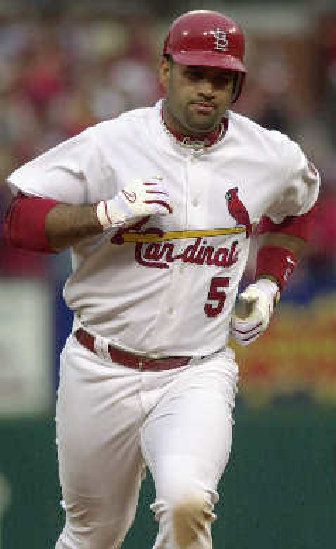
ST. LOUIS – I must admit up front that it’s difficult to write a column about the MVP voting in the National League, because the last thing I want to do is disparage Ryan Howard.
There is so much to admire about the big fella from Lafayette High in St. Louis who used his prodigious power and amiable personality to conquer the notoriously tough town of Philadelphia.
Howard is an outstanding guy, friendly to everyone. He hasn’t forgotten his hometown, or his family, or his old friends. Fame hasn’t affected Howard, who has remained true to what he is: a genuinely nice human being.
Howard is also a remarkably scary power hitter. And Howard will have a special career because he works so hard on his hitting; his determination to improve a weak spot in his stroke by mastering the inside pitch is the No. 1 reason he cranked 58 homers in 2006. And no question, Howard boosted the Phillies and played a leading role in keeping them in contention for a wild card spot long after most pundits counted them out.
I’m happy for Howard. He’s worthy of the MVP Award. He had a sensational season and was a sensational story, and that carried the vote. More than anything, sportswriters root for stories, and root for moments. And Howard simply had an electric presence this past summer. For pure thrills, oh-my-gosh swings of the bat, and must-see TV, Howard was the most spectacular player in baseball in 2006.
That said, the voters got it wrong in choosing Howard over the Cardinals’ Albert Pujols for the MVP.
The error in the N.L. voting wasn’t nearly as egregious as the incomprehensible selection of Minnesota first baseman Justin Morneau as American League MVP. (Morneau was, at best, the third-most valuable Twin behind catcher Joe Mauer and pitcher Johan Santana; so how in the world was he tabbed as the MVP of the entire league?)
In the N.L., Pujols once again played the role of Henry Aaron, ironically penalized by his annual excellence, which the supposedly knowledgeable baseball writers clearly take for granted. Aaron won only one MVP award in his career; his constant drumbeat of offense often was overshadowed by another player’s more dramatic and thunderous production. And so it goes with Pujols, who in his six major-league seasons has captured one MVP award while finishing second in the voting three times, third once, and fourth once.
Pujols’ brilliance is dispensed on a daily basis in a variety of ways. It’s wonderful stuff if you get a chance to see Pujols’ skill set on display. The way he saves runs with his Gold Glove fielding at first base. The way he takes an extra base with his instincts as a runner. The way he’ll ignore the temptation to pull the ball, and instead rifle an outside pitch to the opposite field to deliver an RBI single. But if you are a baseball writer in another market, you won’t see the more subtle elements of Pujols’ game illuminated on ESPN’s “SportsCenter;” what you’ll see is lots of home-run highlights, accompanied by the soundtrack of awestruck announcers.
Remember the baseball marketing slogan, “Chicks dig the long ball?” Well, baseball writers dig the long ball, too. They’re just as seduced by home runs and RBIs as any fan in the stands. I would hope that my colleagues would be more discerning, but it isn’t the case.
Here’s why Pujols was the MVP:
“If you want to use the more traditional statistics, Pujols was the only hitter in the N.L. to finish in the top five in average (third), homers (second), RBIs (second), runs (fifth), on-base percentage (first), slugging percentage (first), and batting average with runners in scoring position (first).
“If you want to use sabermetrics, Pujols was first in the N.L. in Value Over Replacement, first in Win Shares, first in Equivalent Average, first in Runs Created, first in Win Probability Added.
“If you want to zero in on clutch hitting, Pujols led the N.L. with a .397 batting average with runners in scoring position. Howard ranked 51st in the N.L. with a .256 average with runners in scoring position. With runners in scoring position and two out, Pujols hit a preposterous .435. Howard batted .247.
Many years from now, when perplexed baseball historians look back on all of Pujols’ second-place finishes, they might wonder if the baseball writers owe Pujols an apology.