
Hanging on to harvest
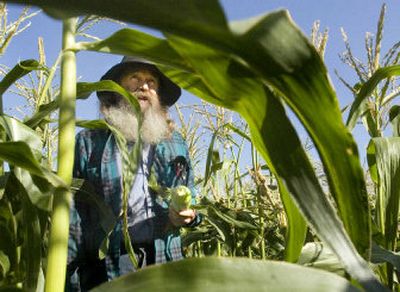
There are acres of corn still in the field at Dave Gilbert’s farm on Progress Road. Green tomatoes hang on the vine. The Hubbard squash are swelling to the size of black Labradors.
But this month marks the beginning of the end. Gilbert, who insists his garden will grow as long as he turns on the water, will soon be taking his 51/2 acres off life support.
With the turn of a tap, a 10-month journey measured in inches and pounds will be over. The drying stems and stalks will deliver one final pulse of sweet summer glucose to their fruit. Frost’s kiss will kill the squash vine and Gilbert will disk the remains back into the soil.
“You know what that year is like?” Gilbert asks. And then fishing the answer from thin air, he holds his pinched fingers up to his face and blows. “Poof.”
Gilbert, 57, looks the part of a Dust Bowl farmer, with his flat-brimmed trail hat darkened around the band and caked with years of sweat and field dust. On a day when the temperature promises 80 degrees and almost delivers, the farmer wears two long-sleeved shirts, the outer one a flannel plaid. His red beard conceals most of his face and neck.
Gilbert’s parents, Vic and Onita Gilbert, started this farm at 602 S. Progress Road in 1949. Vic Gilbert passed away several years ago, but 75-year-old Onita still walks up and down the garden rows in a floppy straw sunhat filling orders for whoever pulls into the driveway.
There’s just enough corn beside the old spring scale in front of the Gilberts’ home to fill a small order, but anything more than a dozen ears sends them driving around the block to one of their sharecropped fields to pick more. It’s on such a trip that Dave Gilbert starts talking about what determines corn’s sweetness.
“It’s genetics mostly,” Gilbert says, handing out ears of small-kerneled white corn and super sweet bicolored corn for comparison. “Go ahead and bite it.”
One guest picks kernels from the cob and nibbles thoughtfully. The other takes a huge bite and finds the bicolor ear candy sweet, while Gilbert explains that the other factor in corn’s sweetness is weather, the good fortune of the hot dry days and warm nights. A farmer could take some credit for growing the corn, but really the farmer just keeps the stalks watered, Gilbert says. It’s really up to genetics. A cherry tomato is never going to be an heirloom Cherokee. It may be a specimen of a cherry tomato when its life ends, but so much of that depends on luck.
The Gilberts seemed destined to be farmers, as if it were written in their DNA. There’s a rock wall on the property’s northern edge that tells the tale of the family’s relationship with the land. It is 4 feet high, several feet wide, and deeper than the postage-stamp building lots that have sprung up in the area lately. The stones in the wall come from the Gilberts’ field, which sheds them every spring like baby teeth. In turn, the family has stacked the watermelon-size boulders to shield itself from a seemingly endless supply of new homes emerging on what used to be farmland to the north.
“We used to farm that land before they got tired of growing crops and decided to grow houses,” Dave Gilbert says. The properties couldn’t be more different.
Here on Progress Road, the Gilberts work their soil with an Erector Set of a tractor so old it lacks the hydraulics on which modern farm equipment has depended for nearly 60 years. The disk harrow mounted to the tractor’s front was originally designed for a horse. It was this kind of equipment that helped plant the seeds of the Gilbert family farm some 57 years ago. At times it seems like only yesterday that the family was getting its start, Onita says. And then she looks at the tired plants that have just now begun to produce their best fruits even as her son readies to turn off the irrigation spigot.
“It’s just like life,” Onita says. “Where did it go?”