
Standardized treatments help cancer center streamline care

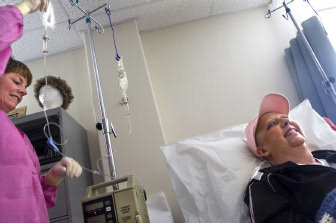
If there were five different ways to treat the breast cancer she has battled since 2001, Kathy Murphy didn’t know it. All the 50-year-old Spokane Valley woman knew was that Cancer Care Northwest was in charge of keeping her around for her grandchildren, Jacob, 5, and Annabelle, 2.
“A week after I found out that I was going to be a grandma, I found out I had cancer,” said Murphy, who sports a baseball cap over her nearly bald head and a sparkling pendant over the radiation scar on her chest.
“I’m not ready to go. I want to be here. I have breast cancer, but I also have things to do.”
Murphy is a patient at the regional cancer center that has partnered with a leading insurance company to investigate the many options for treating her disease. Together, Cancer Care Northwest and Premera Blue Cross insurance have created a program aimed at changing the way cancer is treated here and across the country.
Through a cooperative agreement crafted over nearly four years, Murphy and other patients are receiving care that advocates say has been standardized to provide maximum medical effectiveness at minimum cost.
“We’re out to transform the cancer care delivery system,” said Dr. Bruce Cutter, president of Cancer Care Northwest and the region’s chief proponent of the Foundations of Quality program, which routes cancer treatment through what he calls “clinical pathways.”
That means that the doctors who care for Murphy and others have agreed to provide the same treatment in the same way for patients with similar kinds of cancer – unless there’s a good reason not to.
It’s an approach that now is being considered a model by U.S. Oncology, the national agency whose providers treat between 10 percent and 20 percent of all cancer across the country.
“You might not know this, but oftentimes there are two or three or four or five treatments for you,” Cutter explained to Murphy on a recent afternoon.
Under the pathways project, doctors reviewed the range of potential treatments and evaluated them according to several criteria.
First and most important, Cutter said, they chose treatments that were similarly effective according to accepted medical standards. Then, they screened those options for secondary characteristics, such as side effects.
“Maybe you’ve got one choice that’s as effective as the other, but this one makes you sicker than crap and this (other) one doesn’t,” Cutter told Murphy.
Finally, doctors evaluated the treatments according to cost. Cutter emphasized that expense is always the last factor considered.
“You’ve got to put the stethoscope before the calculator,” he said.
But when it comes to cost, expenses for similarly effective treatments can vary widely, said Dr. Dave Johnson, regional medical director for Premera Blue Cross.
One treatment for lung cancer, for instance, costs about $13,000 less than another procedure that produces similar results. In that category of treatment alone, Premera officials estimated they could save up to $1 million in treatment and drug therapy costs, Johnson said.
So far, Premera and CCNW have created standardized pathways for several of the most common kinds of cancer, including breast, lung, colon, prostate and ovarian cancer.
At first, some doctors objected to the idea of standardized treatment, mostly because they believed it eroded some of the autonomy of their practice.
“Doctors have been free to do whatever they wanted to do with their patients,” Cutter said.
But Linda Nelson, a registered nurse who administers Kathy Murphy’s chemotherapy treatments, said the stability of the pathways model is better for workers and patients.
“With as many providers as there are, there’s a tendency to have their own little idiosyncrasies,” Nelson said. “The pathways bring that into some sort of consistency.”
Early critics of the program – doctors, especially – fretted about installing rigid standards that didn’t allow for deviation.
“I don’t think anybody wants to practice cookbook medicine,” said Jan Monaco, chief executive officer of the Spokane County Medical Society. “And all of us as patients want to think our doctors are looking at us individually.”
But the pathways concept allows for deviation as long as the alternative treatment is approved by a committee of peers, Cutter said. It’s also flexible enough to incorporate cutting-edge treatments or techniques.
“It’s pretty hard to criticize us,” he said.
In fact, the aims of the pathway project are in line with the direction Washington doctors want to go, said W. Hugh Maloney, president of the Washington State Medical Association.
The philosophy creates a framework for practicing more evidence-based medicine, which has been a state goal for about 15 years.
After reviewing the program, Maloney said he was impressed with the unusual level of collaboration between CCNW and Premera, and by the idea that doctors were leading the reform.
“He’s doing it the right way,” Maloney said of Cutter. “And it sounds like the kind of program the physicians can support. I applaud them for that. It’s the docs looking out and making the call.”
For Kathy Murphy, who’s partway through a three-month chemotherapy regime, the program is just another feature of quality care.
“I didn’t know about the pathways,” she admitted. “But I think, in a way, I’ve always kind of known my doctor was doing this.”