
Language can be barrier for 911 dispatchers
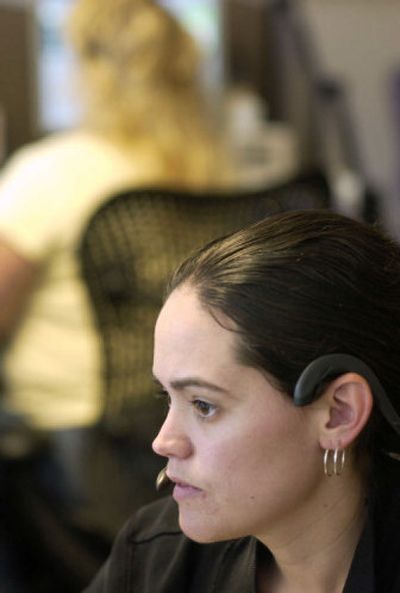
SALEM – Fielding frantic 911 calls is challenging enough, but imagine if the caller speaks a foreign language.
“There is an issue that comes into play when it comes to language barriers,” said Lt. Bill Kohlmeyer of the Salem Police Department.
Spanish calls are the most common foreign-language 911 calls phoned in to the Willamette Valley Communications Center, which fields emergency calls and dispatches for 18 police and fire agencies in Marion and Polk counties. The center has one dispatcher who is a certified Spanish-language speaker, supervisor Susan Hurley said.
With the area’s fast-growing Hispanic population, public agencies and private companies are searching for ways to communicate with their customers.
In Marion County, Hispanics are the largest minority group. They now make up 21.3 percent of the population, according to the U.S. Census Bureau’s 2005 American Community Survey. That’s up from 17.1 percent in 2000.
Of Hispanics 5 and older in Marion County, an estimated 83 percent speak Spanish, according to the 2000 census, the latest data available about foreign-language speakers in the county.
It’s not just 911 services that are adjusting to the change; utility companies are, too.
One way they are doing so is by using Telelanguage, a Portland company that has workers who interpret 150 languages, 24 hours a day, year-round, said Andre Lupenko, the company’s president.
“It takes … 12 to 15 seconds to reach one of our interpreters for most commonly used languages, like Spanish,” Lupenko said. “For less-common languages, it may take up to 45 seconds to reach an interpreter.”
At the Willamette Valley Communications Center, dispatchers keep the Telelanguage number on speed dial.
The 911 center averages about 110 calls per month to Telelanguage. It pays Telelanguage $700 to $800 per month for its interpretation services, Hurley said.
Once a call is placed and the interpreter gets on the line, “We stay on the line and work with the interpreter to gain the information we need to determine the appropriate level of response,” Hurley said. “The most important item is to determine what the caller’s emergency is.
“Our goal is to get assistance on the scene as quickly as possible and to get the situation under control.”
The Salem Police Department has added bilingual officers to its patrol units.
“We now have 17 officers who are certified in Spanish,” Kohlmeyer said.
Similarly, of the 40 officers with the Keizer Police Department, seven are fluent in Spanish, said Keizer police Capt. Jeff Kuhns.
When 911 dispatchers call the agency, they tell officers if they are responding to a call from a Spanish-speaking person.
“These calls are handled by our Spanish-speaking officers,” Kuhns said.
When those officers are not available, the agency works with other police agencies to dispatch a Spanish-speaking officer to the scene, Kuhns explained.
“We, in turn, will also send our Spanish-speaking officers to them if they request our assistance,” he added.
At the Marion County Sheriff’s Office, a total of 16 deputies speak Spanish, spokesman Kevin Rau said.
Eight of those work in patrol units, while the other eight work at the Marion County jail, he said.
Some public-service agencies, such as Salem Public Works, also tap Telelanguage for help with foreign-language speakers.
“Telelanguage has been an effective service for us,” said Mike Gotterba, the emergency-preparedness manager for Salem Public Works.
“We deal with other languages, like Russian, but Spanish is the most common foreign-language we deal with,” Gotterba said.
In addition to using the telephone interpretation service, the agency also has a dispatch center that deals with emergency calls involving broken waterlines, downed trees, backed up sewer lines, chemical spills and street flooding, Gotterba said.
“Whenever we have to leave doorknob notices at people’s homes telling them about work being done in the area or, for example, about clogged storm drains, the notices are in English and Spanish,” Gotterba said. “We started doing that two years ago.”
The front office at Salem Electric, which serves West Salem and parts of downtown Salem and Keizer, is staffed by four customer service representatives.
“Two of those speak Spanish,” said Jack Belleque, the company’s administrative services manager. “They handle 95 percent of emergency calls from Spanish-speaking customers.”
If an interpreter is needed for reasons other than an emergency, the electric company also uses Telelanguage’s services.
“But that’s not used very often,” Belleque said.
However, during non-business hours, foreign-speaking callers are on their own.
“Spanish-speaking customers (with an emergency) may have to call the police,” Belleque said.
That’s because the after-hours answering service with which Salem Electric contracts does not have any Spanish-speaking operators, he said.
“We may ask the answering service to consider hiring Spanish-speakers, but whether or not they’ll do it is up to them,” Belleque said.
Portland General Electric customers who speak a foreign language also might not be able to get immediate help in an after-hours emergency.
“We can’t guarantee that a Spanish speaker, for example, will be available, but we attempt to get people to call 911,” said Steve Corson, a PGE spokesman, adding that they also leave bilingual notices at customer’s homes.
“Not all of them are, but we’re working on that,” Corson said. “We recognize that it’s a growing market.”
Of the total 90 workers at the NW Natural call centers in Salem and Portland, two speak Spanish, said Tom Gauntt, a company spokesman.
For large-volume calls from Spanish- and other foreign-language speakers, the gas utility company, which has more than 600,000 customers across Oregon, taps AT&T Language Line for interpretation services.
After hours, an automated answering system prompts callers on what to do in case of an emergency.
“Except that the menus don’t prompt callers in Spanish,” Gauntt said. “And while the third-party translation company is a resource we can draw on, the downside is that whenever you have a third party involved you increase the chance of miscommunication.”