
Few attend Valley growth hearing

A sparsely attended hearing Thursday night looked at Spokane Valley’s piece of what will be the most significant decision on development in Spokane County in the next five years.
As part of an update to its comprehensive plan, Spokane County is considering requests by landowners to expand the area where non-rural housing and business are allowed to develop, known as the urban growth area.
On land near Spokane Valley and Liberty Lake, owners of more than two dozen properties totaling about 2,800 acres have asked that their land be opened up to residential and commercial development. That total rises to 3,900 acres if a request to expand the Legacy Ridge subdivision west of Liberty Lake, submitted after the comment deadline, is considered.
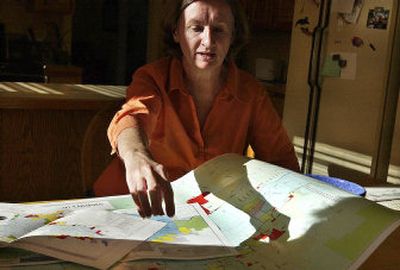
Gail Stiltner’s neighbors have been fighting a new development in Spokane Valley’s Ponderosa neighborhood for two years, arguing that roads into the area are not adequate for evacuating residents if there is a fire, that the development will hurt wildlife and that it will overburden utilities. While most of those people discuss things like soil stability, wildlife corridors and traffic counts as if they were the weather or baseball, they didn’t find out about the project until one of them happened to be applying for permit at City Hall.
“Nobody knew what was going on,” said Janice Cooperstein. By the time most residents were aware of the development, its addition to the urban growth area had already been approved.
“Everyone up here, when they found out, said ‘We didn’t get any notice,’ ” she said.
The county commissioners in August adopted criteria they will use to evaluate each request, and only the properties that meet them will be considered. Property that is contiguous to the present growth boundary or within areas designated by the county as urban reserve will be considered. They also must have adequate roads and other infrastructure nearby to support development on them, including sewer lines. Additionally, areas currently zoned as rural-conservation lands should be excluded from the new urban growth area, according to the county’s criteria.
By far the largest request to be included in the urban growth area near Spokane Valley addresses 1,100 acres near East Valley High School owned by Timberwood Ranches LLC.
A lawyer representing the owners argued at Thursday’s hearing that, although it is zoned rural conservation, the land is suitable for development because it borders new housing and will have easy access to sewer and water facilities. Traffic from new development could be handled by improvements to Bigelow Gulch and Forker Roads, he said.
Timberwood Ranches LLC has donated $1,000 to Commissioner Phil Harris’ re-election campaign, according to the latest data from the Public Disclosure Commission.
It did not donate to opponent Bonnie Mager’s campaign. And although lawyers representing some of the landowners have made political contributions during this election cycle, Timberwood Ranches appears to be the only company or landowner involved in a Spokane Valley urban growth area request that has donated to either campaign.
Whether its request or any of the others is included in the growth area is ultimately up to the county commissioners.
The Spokane Valley Planning Commission held Thursday’s hearing, which was extended until their next meeting.
Public comment will be taken throughout the process. The Planning Commission will make a recommendation on new urban growth areas to the City Council. The council will make its recommendation to the Steering Committee of Elected Officials from around the county, which will then forward its recommendations for growth area expansions on to the commissioners.
“What they (county planners) are analyzing is much larger than our proposal,” said Spokane Valley planner Scott Kuhta.
As part of the process, each city must analyze how much land inside its borders can still be built on and how many new people could live there.
Based on recent population estimates selected by the county for the next 20 years – which many jurisdictions have criticized as unrealistic – Spokane Valley will plan for 33,000 people to move into the city and its surrounding areas.
Accommodating that population estimate is what necessitates adding land to the urban growth area under state law.
Spokane Valley’s land analysis, though, predicts that 20,632 new residents can fit within the existing city limits.
Five areas that planners have located just outside the city can hold the rest, and most of those are within the growth area in place now.