
That thing you do: Tattooist learned through ‘trial and error’

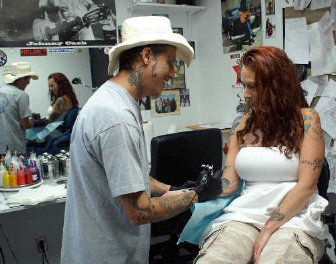
Visiting a tattoo parlor for the first time, I was surprised on two levels. First, the place was swarming with customers, including one gentleman trying to decide how to depict a lion (he was a Leo) on his arm. Second, the facility was spotless with no loud music, booze or cigarettes.
Raymon Farnam, the “Skinny Boy” of Skinny Boy Tattoo and Body Piercing in Coeur d’Alene, explains that “body art” has increased dramatically in popularity over the last 20 years and that he is passionate about sterilization, sanitation and hygiene in his operation.
Farnam, 41, has applied his art to local doctors, police officers, lawyers and even a judge. He admits that as an artist, some of his “canvasses” are more enjoyable to work on than others, but he appreciates the creativity factor. As owner of the business on Seltice Avenue, he overseas a staff that includes Chris “G,” “Spider” and Colin. His wife, Jill, is the receptionist and manager. A job perk for her is all the free body art she wants, a perk that she obviously enjoys.
Born and raised in Southern California, Farnam began tattooing in his teens and was forced to learn the art “through a long road of trial and error.” Skills were honed while working in Mesa, Ariz., San Diego and Venice Beach, and in a couple of other places “not worth mentioning.”
What is your job title? “Tattoo artist.”
How long have you been doing this? “Eighteen years.”
How did you choose this line of work? “I stumbled into it. I was at a friend’s house and he was getting a tattoo, I liked it, so went home and did one of my own. I made my own tattoo apparatus from the motor of my telephone answering machine and a guitar string.” He adds that his creation is now in a tattoo museum.
Are you paid: (a) well; (b) more than you are worth; (c) slave wages, (d) could be better? “We earn far below what tattoo artists earn around the country. There are not a lot of ‘professionals’ in this area, so that drives the price down.” He adds that people shouldn’t haggle with tattoo artists and should remember that prices from well-established, reputable artists will be higher.
What is the best thing about your job? “The artist creativity and meeting different people all the time.”
What is the worst thing about your job? “What some people demand may not translate into reality.” Farnam adds that, like for any artist, there are good and not-so-good canvasses and it’s the same with bodies. More than anything, he hates to see the nonprofessionals with unprofessional and unsafe shops. He points out that, in Idaho, a person who wants to cut hair for a living is required by law to complete 2,500 hours of educational training and pass a state board exam, and “no one can perform a single stitch without a medical degree.” In contrast, “anyone can push a hypodermic needle through any part of your body and implant a piece of jewelry with no training at all.”
Do you plan on doing this job (a) until retirement; (b) until something better comes along? “I have another year or two in me, then I plan on leaving my business in the hands of my staff and hitting the road on my Harley.”
Do you have any on-the-job funny stories? “A guy came in and said he only had $80 to spend. He was standing next to a photo of a tattoo of a large black woman sitting. I said I would put the black woman, sitting on a gold toilet, on his arm for $80 and he went for it.”
Any bad experiences? “Some customers are just a pain in the rear.” He adds that some people whine, that woman seem more pain-tolerant, but they’re also more dramatic. He estimates that it evens out between male and female whiners.
If there was a movie made about you and your job, what actor should play you and why? “Johnny Knoxville or Steve O of MTV’s ‘Jackass,’ because I can be stupid like that, too.”