
Hunters drop big bucks
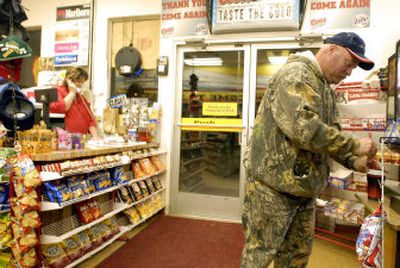
ST. MARIES – It’s 5:30 a.m., and Chuck Petersen is in a hurry to get to a certain little swamp in the St. Joe River basin.
When the sun clears the foothills of the Bitterroots, Petersen will be waiting – rifle in hand – for the deer to start stirring. If luck is with him, the hunter from Calder, Idaho, will bag a buck.
At the moment, however, Petersen is plunking down $10.95 for a “Heavy Horns” rattle bag. The deer call mimics the clashing antlers of fighting bucks. “I sell a lot of them,” says Marcie Telford, co-owner of St. Joe Sport Stop.
In the 90 minutes before dawn, a constant flow of men in camouflage passes through the St. Maries convenience store. They’re buying gas, doughnuts, jerky and jolts of caffeine in the form of drip coffee, Diet Coke and Mountain Dew.
The purchases contribute to hunting’s clout as a $540 million industry in the state of Idaho.
About 200,000 people hunt in Idaho each year. They spend an average of 10 days in the woods and collectively drop $300 million into retail purchases, mainly in rural communities.
Greg Steinbach, Petersen’s hunting partner, got his kill on Friday: a cow elk that will fill his freezer this winter. It’s costly meat.
“I spent $800 just on tags and licenses,” said Steinbach, who paid higher, out-of-state license costs because he’s from Bellingham.
Add the cost of gasoline, gear and a week off from work, and it’s cheaper to buy your meat in the grocery store aisle. But an anonymous slab of beef can’t compete with the elk steak you tracked on foot through the mountains, Steinbach said.
“I started hunting when I was 12,” he said. “It’s recreation.”
St. Joe Sport Stop, which Telford and her husband have owned for eight years, advertises “Gas, Guns, Tackle.” The convenience store and its sporting goods annex sell more than $100,000 worth of licenses and tags each year.
“This is the last day of cow elk season?” one of Telford’s customers asked on Saturday morning.
It was, creating a sense of urgency for hunters who still hoped to bag their elk.
“I missed a big six-point two times last weekend,” said Jordan Hammons, of St. Maries, lamenting the loss of the trophy elk as he filled his coffee cup.
Jason Brebner had already shot his elk; his bear, too. On Saturday, the bow hunter hoped to get a whitetail deer. He’d worked the swing shift at Potlatch Corp.’s mill in town, grabbing a few hours of sleep before heading out early to go hunting.
“If you get an animal,” Brebner said, “you don’t need to sleep.”
Ed Mitchell, a spokesman for the Idaho Department of Fish and Game, said $540 million might even underestimate hunting’s contribution to Idaho’s economy. The figure comes from a report compiled every five years by the International Association of Fish and Wildlife Agencies.
The report tracks indicators such as retail spending, license fees, and salaries of people employed directly by the industry, then gauges how that money ripples through communities.
According to the report, the hunting industry employs 6,000 people through direct and indirect jobs. The figure rivals the number of Idaho residents working at Wal-Mart.
Dollars spent by hunters are valuable because they’re so widely dispersed, and so often flow to small businesses in rural communities, Fish and Game officials said. Out-of-state hunters, or even Idaho hunters who travel long distances, are particularly lucrative tourists.
“Hey, I left $800 in North Idaho just last month,” Mitchell said.
His wife, Sharon Watson, had her name drawn for a moose tag. The couple spent eight days at Priest Lake, paying for lodging, meals and new equipment, including a winch powerful enough to drag a 750-pound moose carcass into the back of a pickup.
“She was shooting at something the size of a draft horse,” Mitchell said.
Watson left Priest Lake without filling her tag. She had a moose in her sights but dusk was falling, so it ambled off into the brush, free for another day.
Some sportsmen scout prospective hunting grounds months in advance of the season opener. By the Fourth of July, they’re also prowling the aisles at the Army-Navy Store in Coeur d’Alene.
“They either want wool pants or a backpack,” said Manager Lois Huber. “They’re starting to think about the first items on their list.”
Army-Navy outfits hunters with Carhartt overalls, red-and-black checked shirts and long johns spun from merino wool. Boot fitting is a store specialty. A 50-foot display wall advertises “Made in the USA” boot brands from $99 to $299. Another 25 feet of wall space is devoted to sock displays.
“We sell an awful lot of socks,” Huber said. “A good sock is a lot of what makes your foot feel wonderful in the boot.”
Hunting season is also a busy time at Tim’s Special Cut Meats Inc. in Coeur d’Alene. Wild game accounts for one-third of the revenue during the fall, said owner Tim Branen. Before the end of the year, the shop will process about 1,000 head of deer and elk.
Branen charges 50 cents per pound for custom elk butchering. Much of the venison, however, leaves the shop in packages of sausage or jerky.
“We book up real quick,” Branen said. “It’s on a first-come, first-serve basis, so we tell people to call as soon as they get their animal.”
For hunters heading up the North Fork of the Coeur d’Alene River, H&H Riverstop is the last call for gas and groceries.
Up to 30 hunters per day pass through doors of the Prichard store this time of year. Some are dropping off their kills at the cold storage – a converted milk truck that keeps carcasses at an even 30 to 35 degrees and prevents blow flies from spoiling the meat. The cash register also rings with sales of coffee pots, propane, bug spray, hot dogs and snack foods.
“Surprisingly, I sell more ice cream than beer,” said Peg Hammeren, H&H Riverstop’s proprietor. Even when temperatures drop below freezing, hunters buy ice cream cones filled with scoops of Moose Tracks, Caramel Caribou and Bear Claw. “We stay with the animals,” she said.
Some of her customers smell like animals, too. They’ve doused their clothes with the urine scents of deer and elk to mask the predatory human smell. “It takes the Downy out,” one hunter said.
Hammeren sells the scents, but keeps them behind glass to cut the odor.
H&H Riverstop’s country store atmosphere encourages customers to stay and swap stories. Bow hunters tell Hammeren about hearing wolves howl in the remote ridges backing up to the Montana border. Hammeren herself has stood on a trail with her rifle in the misty, pre-dawn darkness, listening to a bull elk bugling. The primitiveness of the sound never fails to stir her.
“The hair on the back of your neck just rises,” she said.
Every year, Hammeren watches for a certain group of hunters, who travel all the way from Florida and Georgia to set up elk camp in Idaho’s national forests.
“Probably 50 percent of them go home with nothing, not even a little deer,” Hammeren said. “They spend a lot of money for the privilege of hunting in Idaho, and they appreciate it.”