
Iraq timeline offered
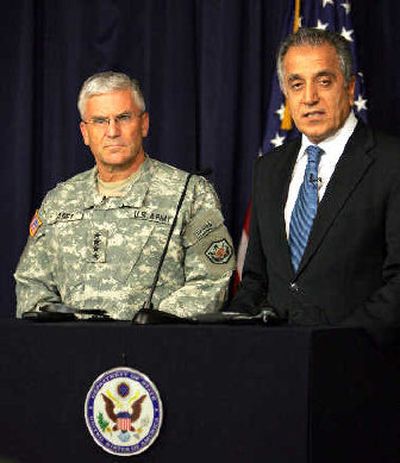
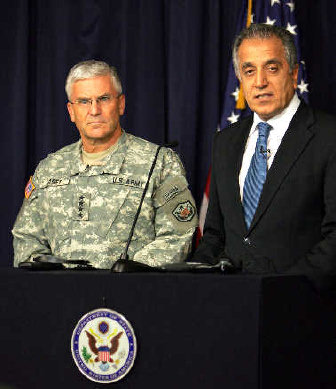
BAGHDAD, Iraq – With the Bush administration facing mounting election-year criticism of its Iraq war strategy, the U.S. ambassador and the top American general in the country said Tuesday that Iraqi troops would take over most security functions within 18 months and that Iraqi leaders would set a timetable for solving their most explosive political issues.
At the same time, Gen. George Casey, the commander of U.S. forces in Iraq, said he wouldn’t hesitate to ask for an increase in U.S. troops to complete the task of stabilizing the country.
The upbeat assessment from Casey and U.S. Ambassador Zalmay Khalilzad came at a rare news conference the two gave in Baghdad during one of the most violent periods in the three-and-a-half-year-old war, and just two weeks before midterm U.S. congressional elections.
The two spoke on a day when the deaths of four more U.S. troops were announced: two Marines, a soldier and a Navy sailor. That brought October’s grim toll to 91, the deadliest month for American troops this year.
While Khalilzad said Iraqi leaders had agreed to set a timeline for easing sectarian strife, controlling militias and sharing oil revenues, Casey insisted that U.S.-trained Iraqi security forces were making steady progress toward assuming more responsibility, despite previously missed deadlines for them to do that and serious concerns about their performance under fire.
“We are about 75 percent of the way through a three-step process in building those forces,” Casey said. “And it’s going to take another 12 to 18 months or so until I believe the Iraqi security forces are completely capable of taking over responsibility for their own security – still, probably, with some level of support from us.”
The two officials offered the news conference to herald progress by Iraqis and to assert that U.S. military and civilian leaders were acting nimbly in changing tactics as needed on the ground. But their remarks were greeted with skepticism from some Democrats in Washington, who are banking on growing public dissatisfaction over the war to deliver them control of the House and Senate in the midterm elections.
Public opinion polls in the U.S. show opposition to the war is mounting.
Sen. Jack Reed, D-R.I., a member of the Armed Services Committee, said that the Bush administration has presented Americans with constantly shifting goal posts in the war, making it difficult to believe that these objectives can be met.
“I’m encouraged they’re talking about timelines, but these timelines have to be backed up by real concerted efforts that are not revoked 24 hours after they’re invoked,” Reed said.
U.S. commanders on the ground have reported that progress with Iraqi security forces has been uneven at best and that Iraq’s army seems a long way from operating independently. President Bush and U.S. commanders have repeatedly said that a U.S. troop reduction hinges on Iraqi forces showing a greater capacity for their own security.
While more than 300,000 troops have been trained and equipped, the Iraqi army units have been plagued by absenteeism and desertion. The Iraqi police also have been hampered by corruption and riddled with officers whose loyalties lie with sectarian militias.
In the few areas that Iraqi forces control, they have frequently proven to be ineffective.
British troops moved out of the southern city of Amarah, the site of an uprising last week by the Mahdi Army militia, in August. In September, U.S. troops handed the Iraqis responsibility for the city of Balad, where as many as 100 people were killed earlier this month over three days of sectarian violence.
One retired U.S. Army colonel, Doug Macgregor, said in many cases Iraqi battalions that are supposed to be 750-member units have as a few as 120 men on duty at a time. Casey’s assertion that Iraqi troops could be given the reins militarily in as little as a year is “pure nonsense,” Macgregor said. “They will undertake nothing unless they are with U.S. forces,” said Macgregor, who has written extensively on tactics and reforming the army and who is studying the Iraq war. “They are hopelessly factionalized, with all-Shiite units, all-Sunni units.”
In the past, Casey has said that he anticipated a reduction in U.S. troop levels as more Iraqi troops were trained and equipped. But Casey indicated on Tuesday that he wouldn’t rule out increasing troop levels if he thought it would help win security.