
Accord shifts from family to sport
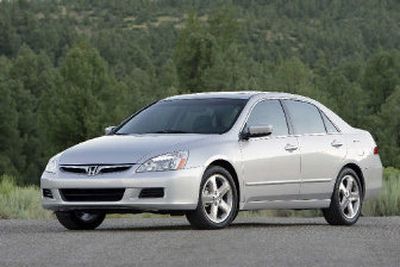
The conceit of the midsize family sedan is a little frayed around the edges these days.
Turns out families don’t buy sedans anymore. They buy SUVs, CUVs (Crossover Utility Vehicles) and the occasional minivan.
Empty-nesters buy sedans, says Honda. Half of all its midsize Accord sedan sales are to couples whose children have flown the coop. Singles and childless couples account for another 25 percent.
Since families are among those least likely to buy an Accord, Honda has redefined its flagship. Beginning with its 2003 remake, it has grown both sportier and more luxurious. Not BMW sporty or luxurious, but sporty enough to make things interesting and luxurious enough to keep comfort-oriented buyers loyal to the brand.
Accords are available in a wide range of styles. There are four- and six-cylinder sedans and coupes and a hybrid sedan. The base Value Edition sedan is priced from $19,990, including destination, while the top-of-the-line EX-L V-6 comes within a hair’s-breadth of $30,000, at $29,9950.
Those models bookend a huge variety of alternatives; all told, there are 19 versions of the sedan alone.
Want to option your four-cylinder Accord with leather, voice-activated navigation, sunroof and enough airbags to still your neurotic tendencies? No problem. A four-cylinder Accord optioned to match the EX-L V-6 rings out at $27,645. And you can take yours with either an automatic transmission or a stick.
Even the Value Edition Accord gets air conditioning, cruise control, remote keyless entry, power windows and locks, a full complement of airbags (including curtain-style bags), folding and lockable rear seatback, tilting and telescoping steering wheel and an AM/FM/CD audio system.
The base engine is 160-horsepower, 2.4-liter VTEC inline four. There’s an optional 244-hp six and a hybrid system that makes 253 hp and a sturdy 232 foot-pounds of torque. The hybrid is fully equipped right off the showroom floor at $31,685. Nav adds an even $2,000.
Anti-lock brakes, with brake assist and electronic brake assist, are standard. Stability control is standard on V-6 trims.
Because this is such a competitive category, prices have been stable over the past few years; a fully equipped Accord exerts downward price pressure on its competitors, so if you’re looking for value, look first to the midsize sedan segment.
The Accord is one of two undisputed leaders in the category, the other being Toyota’s sales-leading Camry. Both are exceptional, but Honda distinguishes the Accord with a driver-orientation lacking in the Camry.
“We tried to make a serious sport sedan out of the Accord,” one official told USA Today at its ‘03 launch. That decision wasn’t based on market research, he said; “it just seemed like a fun thing to do.”
One example: a six-cylinder Accord can be ordered with a six-speed manual transmission. Toyota offers only a five-speed stick and only on four-cylinder editions of the Camry.
Obviously, it’s the rare Accord driver who will run a few laps at track day, but a good six-speed will enliven even the most prosaic drive. Especially when the road develops a few kinks.
Whereas a well-equipped Toyota will remind you of a Lexus by another name, Honda leaves a little grit in the experience. Steering is light — much lighter than a Bimmer’s, for example — but it’s precise, communicative and dead-on at center.
One also receives fairly high levels of tactile road-awareness. The suspension is tuned to pass along useful information about the road surface; lumps and bumps don’t disappear behind a scrim of shock settings and subframes but instead are rendered civil.
More road noise infiltrates the Accord’s cabin than that of a Camry, which appears to be purposeful. Perhaps Honda simply rejects the notion of the antiseptic driving experience. Even the thick heft of the steering wheel implies a seriousness of purpose.
The Accord’s interior is not the most aesthetically pleasing of all the midsize sedans but it is extremely functional. The front seats are well cushioned yet completely supportive and the cabin is arranged to provide the driver easy access to everything that matters. Controls and gauges are large and clearly marked and visibility is excellent in all directions.
A pair of rear-seat passengers will enjoy good leg- and headroom, but three will be a crowd.
Everything here works with smooth precision. The doors that cover storage bins glide open and closed. Interior lights come on at 10 percent of capacity when a door opens and ramp up to 100 percent when the key goes into the ignition. The process is reversed during shutdown.
Exterior design is typically Accord — pleasant but not noteworthy. No one buys an Accord to send waves of envy rippling through the neighborhood. With its low hood and bulky tail section, the Accord is pleasant enough in appearance but is not a trendsetter.
The only trend Honda seems inclined to follow is the one that perennially puts the Accord at or near the tops of the sales charts. A family act no longer, it has made the graceful transition into a spirited and comfortable sedan for all purposes.