
RAPID RIVER RAPID RIVER
A few hundred elk, the tug of a threatened fish species and dipping my face into one of the coldest, clearest rivers in Idaho helped cast off doubts about the value of roadless areas.
Confirmation came during an August fly-rodding expedition into the upper reaches of the Rapid River southwest of Riggins after my Parachute Adams settled at the head of a deeper run and drifted perfectly over the dark depths. I was a day deep into the backcountry and the stream was only a few rod lengths wide.
Surprised that I didn’t get a strike over such prime trout water, I mended the line and let the fly continue through the tailout and into a foot of water, where a 9-inch cuttbow rose from behind a rock.
My line tightened. The fish was on.
I was enjoying the little trout’s spunk as I cranked it upstream, but the real fight began just after the cutbow made an escape run out of sight into the deeper water. My rod doubled over as though my fish had suddenly put on another 3 or 4 pounds.
The action caught Scott Stouder’s attention. Trout Unlimited’s western conservation director put down his rod and watched as the darker shape reluctantly came out of the depths. It was a bull trout with my cuttbow in its jaws.
Determined to keep its meal, the bull trout put up a good battle. I reeled it into the shallows near my feet before the bull spit out the cuttbow and flashed back to the security of the depths.
Meanwhile, the frantic cuttbow, still alive and attached to my line, regained its bearings and sped upstream, where another torpedo streaked out of the depths and nailed it again. Line peeled off my reel for a few seconds before the second bull gave up and dashed for safety.
I had a similar experience with bull trout a few holes downstream, and then went on 50 yards farther to see another pair of bull trout clearly lurking in three feet of water.
“I’ve never seen so many active bull trout,” I said.
“This is a special place,” Stouder said.
The Rapid River drainage is a roadless gem near Riggins, remarkable for numerous reasons.
It’s the only stream in the United States that Congress has designated as “wild and scenic” solely because of its water quality. That designation for 27 miles of the river in 1975 has been a major factor in protecting the drainage from development.
The West Fork’s headwaters are secure in the Seven Devils portion of the Hells Canyon Wilderness. However, the main stem headwaters are not protected. Idaho Gov. Jim Risch recently unveiled a plan that could leave the river’s headwaters susceptible to logging and road building. Illegal ATV trails cropped up in the headwaters this summer.
Even during spring runoff, the Rapid runs remarkably clear. The headwaters are not fouled by roads or human development, save for trails that usher in hikers and horse riders.
During summer, the river runs uniquely cold through a steep forested canyon that walls out the sun for much of the day. Even in August, and angler walking into this water without waders will soon suffer numb feet .
These are qualities vital not only to bull trout, but also to steelhead and chinook salmon and the crowds of anglers who line up to catch them downstream. The Rapid River watershed is the largest and best remaining aquatic stronghold in the Little Salmon drainage for chinook, steelhead and bull trout, according to Forest Service reports.
Indeed, Rapid River contains nearly 10 percent of the state’s critical habitat for bull trout.
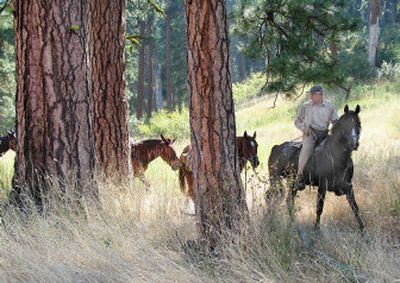
Higher up the slopes, the hundred head of elk we saw that August morning were lounging with calves that had little chance of being disturbed all day, or all week, maybe all month.
Stouder is an hunter, conservationist and angler who lives near Riggins with his wife and stable full of horses and mules. He has a thick album full of photos showing hunting scenes and elk he and his family have bagged in Idaho roadless areas over the past few decades.
He’s been working overtime in recent years to be sure future hunters have the same opportunity. Roadless areas are a key, he said.
“Idaho is the only state in the nation where you can buy an over-the-counter tag and hunt elk for six weeks,” he said. “We have 4.1 million acres of wilderness. California has more than 9 million acres of wilderness. But Idaho has a better net value because in addition to wilderness we also have 9.3 million acres of roadless areas.”
While states such as Washington, Utah, Oregon and Nevada have moved almost exclusively to permit hunts for mature bull elk, many of Idaho’s roadless area still offer a months-long general big-game season, and even modern rifle hunting during the elk bugling season – an opportunity that’s virtually extinct anywhere else in the country.
“It’s because of Idaho’s wealth in roadless areas,” he said. “Without them, we’d lose our liberal general seasons.”
Fishermen have just as much to lose, he said.
“Trout Unlimited research shows that Idaho’s best fish habitat is protected by roadless lands. For instance, 74 percent of Idaho’s chinook salmon and steelhead spawning and rearing areas are within roadless areas. Increasing road density results in declining pool frequency from fine sediments, filling pools, Stouder said. Pool habitat is essential for wintering trout.”
Forest Service officials will be the first to confirm that they don’t have enough money to restore all the streams that have been degraded by roads and associated activities, Stouder said. “And nobody has the money to patrol roads for poaching or illegal off-trail driving.
“The most cost-effective way to maintain wildlife values in our few remaining roadless areas is to keep them roadless,” he said. “These roadless areas are essential to the fish and wildlife we live here to enjoy.”