
Princess Kiko gives birth to male heir to throne
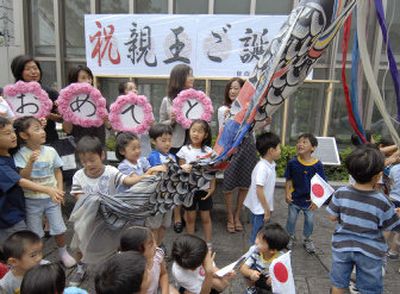

TOKYO – Succession crisis postponed.
Japan’s Princess Kiko gave birth Wednesday to a reportedly healthy baby boy, a 5-pound, 10-ounce solution to the Imperial Family’s need for a next generation heir to the male-only Chrysanthemum Throne.
The baby is the first male born into the imperial family in more than 40 years. He immediately vaults to third-in-line to a throne that claims a mystical lineage of 2,600 years and a male bloodline that can be traced to the fifth century. He will be named within a week.
The birth of a boy would appear to avert, for now, at least, a wrenching national debate between traditionalists and modernists over whether to allow women to accede to the throne. The 39-year-old Kiko’s surprise pregnancy – she is already the mother of 14- and 11-year-old daughters – had stifled the emerging discussion over the Imperial Family’s lack of male heirs.
The baby now follows his uncle, Crown Prince Naruhito, 46, and his father, Crown Prince Akishino, 40, in the line of succession.
He was born in a Tokyo hospital by a Caesarian section that had been scheduled since late August and which allowed Japanese media to stake out the hospital for wall-to-wall coverage on its morning TV shows. National newspapers, which had readied two separate special editions, hit the “It’s a Boy!” switch.
But the birth of a possible future emperor did not trigger widespread public displays of euphoria, despite the media frenzy. Polls show the Imperial Family remains broadly, if tacitly, appreciated by the Japanese public. But emperors have not been worshipped as gods since Emperor Hirohito renounced his claim to divinity after World War II.
Current Emperor Akihito, 72, has no formal political influence, though the imperial institution retains strong symbolic power for nationalists. That group, which includes Shinzo Abe, the man expected to become prime minister this month, earlier this year blocked recommendations by a government advisory panel to revise the 1947 law that prevents women from ascending to the throne.
For many here, the arrival of a new member of the Imperial Family was more a matter of curiosity than constitutional significance. That stems, in part, because of the painful personal drama unfolding behind the curtains of the Imperial Household, where Princess Masako, Naruhito’s Harvard-educated wife, is suffering from a stress-related illness that has drastically curtailed her public appearances and reportedly raised tensions within the royal family.
The couple has only one child: a 4-year-old daughter, Aiko, and the Japanese media attribute the princess’s illness to the pressures on her by traditionalists to produce a male heir. They have also chronicled her strained relations with her in-laws and with the Imperial Household Agency, a fusty institution that manages the family’s public affairs and which has termed Masako’s illness an “adjustment disorder.”
Naruhito has publicly criticized the Agency for its treatment of his wife, a rare criticism that sparked subsequent tensions between the two crown princes, according to royal watchers.
“At times like this we get interested in the Imperial Family, and we get lots of information from TV news shows and weekly magazines, whether we like it or not,” said Chieko Okano, 33, a Tokyo mother expecting her second child in November. “I feel a little sorry for the Imperial Family.”
For centuries, the male lineage was sustained by sons born to concubines of past emperors, a practice the current Imperial Family dismissed.
“We need a grand plan for the long-term future of the nation,” says Professor Hideo Shinozawa of Gakushuin University, who once taught both crown princes. “The old law was supported only by having many concubines and other branch families. I think we should allow empresses.”