
The region’s driving force
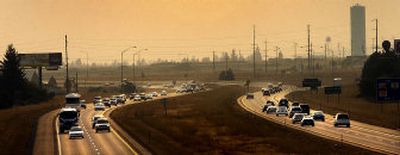
Large aerial photographs from the 1950s swing on metal plates in the basement of the Spokane County Public Works Building.
Taken prior to Interstate 90’s construction, they show Spokane Valley suburbs beginning to take shape, but also depict large swaths of open land and orchards, where street upon street of houses are now located.
I-90 has altered the Inland Northwest’s social and economic landscape in fundamental ways, making it possible for people to live farther from work, encouraging the development of Spokane Valley and Post Falls suburbs and connecting the area and its businesses to the rest of the nation.
For some, the changes have been good – increased opportunities for traditional houses and yards, shorter travel times and business access to markets outside the Inland Northwest.
Others point to the freeway as a leading cause of suburban sprawl, separating people from one another, increasing dependency on automobiles and contributing to the nation’s obesity epidemic.
Large yard within reach
It’s impossible to deny I-90’s impact on development patterns.
The freeway put Spokane Valley and Post Falls homes with large lots within commuting and economic reach of thousands of families.
They moved onto what had been farmland.
As the years passed, both the Spokane Valley and the area around Post Falls became more and more urban – so urban that Spokane Valley incorporated as a city in 2003 with a population of about 85,000 people, making it the eighth largest city in Washington.
“People measure distance in time, not necessarily in miles,” said Bill Grimes, a private planner with Studio Cascade, a local company.
Travel times from the downtown Spokane core to Spokane Valley and Liberty Lake were cut by half or more with the freeway, said Grimes, who wrote a 2003 report on I-90’s impacts. Instead of being an hour from downtown Spokane, Liberty Lake became 20 minutes away.
“The irony is that when you build increased transportation capacity, it saves time now, but the areas are so popular that it grows and fills the (transportation) capacity,” said Grimes.
Global, local commerce
The interstate is a large part of what makes the economy go, said Jerry Lenzi, Washington State Department of Transportation eastern region director.
“You can grow a bushel of wheat as cheap in Brazil as here. What makes us more competitive is our transportation system that gets that bushel to market,” said Lenzi.
Interstate 90 offers the Inland Northwest quick, reliable connections to Seattle, Chicago and the East Coast.
“It maintained the fact that Spokane was a hub, and made it accessible to the rest of the Pacific Rim,” said Howard “Red” Rebe, who worked for the Department of Transportation when I-90 was being built.
Small towns had different ideas about how the freeway would affect them, said Rebe.
Some, like Wallace, Idaho, didn’t want I-90 running right through town. Others, like Sprague, Wash., wanted it in the middle of town because of worries that drivers would bypass businesses.
Businesses on old travel routes certainly did see sales decline whenever a new section of freeway opened.
It’s not difficult to imagine the kind of traffic that used to drive on Spokane’s old Sunset Highway before the freeway bypassed it.
All of the small motor lodges were busy places in the 1950s.
Within days of the nine miles of I-90 opening between downtown Spokane and Four Lakes, Sunset Highway businesses reported precipitous drops in customer traffic and demanded that better signs be installed letting people know how to get to their area.
But signs weren’t enough to save many of those service stations and other businesses.
Spokane Valley businesses along Sprague Avenue also complained when the freeway route avoided them.
And while Wallace preserved its historic downtown by forcing the freeway to go around it, business suffered from the loss of traffic.
But where some stores lost out, others won.
Commercial development has flourished near freeway exits and on-ramps.
Auto-centered community
Communities without highways running through them tend to be denser than those with them, said Clark Williams-Derry, research director at the Sightline Institute, formerly Northwest Environment Watch.
“Living out in a distant suburb is just harder. You can’t get downtown as quickly. That’s one of the reasons Vancouver (B.C.) has had the best results at controlling sprawl,” Williams-Derry said.
According to Sightline, Spokane is the second most sprawling Northwest city after Boise.
“There’s no question that Spokane has developed differently because of its highways,” Williams-Derry said, conceding that the freeway has made it more affordable for people in Spokane to own homes with large yards than Seattle or Vancouver, B.C., residents, where commute times are a bigger concern.
But sprawling development relies on cars, and the more people have to drive, the higher risk of obesity, Williams-Derry added.
A person living in a walkable neighborhood tends to weigh 7 pounds less than someone living in a neighborhood that requires driving to the store, work or school.
Then there are crashes.
“Car crash risk adds up by the mile,” said Williams-Derry.
Spokane County has 10.4 crash deaths per 100,000 residents per year, compared to King County’s 7.6 deaths per 100,000 residents each year, according to the Washington State Department of Health’s Center for Health Statistics.
“The big difference between the two counties is likely in how much people drive,” said Williams-Derry.