
Fuming in Spokane

Elaine and Tim Chapman took a trip to Tacoma over Labor Day weekend and found that gas was a lot cheaper on the other side of the state.
The discrepancy annoyed the North Spokane residents, who saw prices that were 30 cents a gallon cheaper than they were at home.
“That’s what ticks me off is, why isn’t it the same?” Elaine Chapman asked.
Some area motorists, sick of paying gas prices that are among the highest in the nation, are questioning what cosmic forces are conspiring to keep Eastern Washington’s gas prices over $3 a gallon.
According to the American Automobile Association, the average price for a gallon of regular unleaded nationally is $2.62 a gallon, down 41 cents from one month ago.
But Washington is among eight Western states bucking the trend of lower prices, with gallons of gas still clocking in at $2.94 a gallon, according to AAA. The organization says Spokane prices are averaging $3.08 a gallon.
Idahoans share the pain at the pump. Statewide, gas prices are down just 2 cents from a month ago, to $2.98. In Coeur d’Alene, gas prices are averaging $2.90 a gallon, AAA said.
Experts say gasoline prices vary based on where regions get their petroleum supplies, how many gasoline reserves communities have and how much gas is used.
Consumer Federation of America President Mark Cooper had another explanation, in a recent report by that organization and Consumers Union: runaway oil company profits and government policies that fail to protect consumers. The report found that while prices for purchasing crude and processing oil haven’t risen substantially over the past year, the cost to consumers has.
Tim Hamilton, executive director of the Automotive United Trades Association, a nonprofit group based in Olympia, also places the bulk of the blame on big oil companies.
He says most retailers, which his group represents, make at most a dime a gallon on gas sales, and less than that on credit card transactions that carry fees.
Big oil companies like Shell and ExxonMobil limit supplies of petroleum, Hamilton asserted, enabling them to charge American retailers more. In turn, local retailers must also boost their prices.
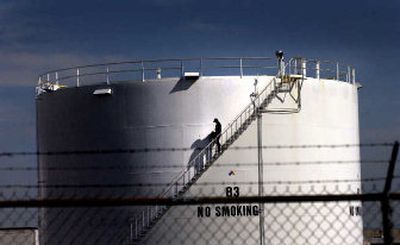
Spokane gets gasoline from pipelines and railroad shipments that carry supplies from Salt Lake City, Billings, Mont., Western Washington and Canada. The gasoline ends up at several local depots, including one operated by Conoco-Phillips Inc.
Hamilton said when more trucks are delivering fuel than are arriving to haul it away for distribution to local convenience stores and other gasoline retailers, the area has a surplus and prices decline. When more fuel is going out than coming in it creates a shortage, causing big oil companies to enact a form of “rationing,” where they raise wholesale prices to limit consumption. In raising prices, those same companies make huge profits, he said.
Retailers are forced to pass along those wholesale gas increases. As the price goes up, people drive less.
Spokane’s prices were lower than Seattle’s earlier this spring, he said, because Spokane had reserves. Now, Seattle has reserves and Spokane is hurting.
“None of this has anything to do with the price of crude oil,” said Hamilton.
While local motorists lament paying more than most of the country for gas, it’s the rising price of diesel that could inflict the most harm to the community, Hamilton said.
Diesel fuel, used for industrial, agricultural and trucking purposes, recently hit an all-time high of about $3.50 a gallon, said Bruce Smith, president of Petroleum Distributing Company Inc, a Spokane business that secures fuel for industrial and agricultural clients.
If this cycle of increasing prices continues, diesel could reach $5 a gallon in the next few years, Hamilton said. If that happens, economic growth in the area could be stunted as farmers and truckers, who are already challenged, are forced to pass along higher prices, impacting what consumers pay for everything from lettuce and beef to toys.
Because school buses run on diesel, further increases also could force school districts to go to voters for more funding, Hamilton said.
“You’re going to see very shortly where schools are going to be screaming for maintenance increases,” he said.
Smith, who has been in the fuel business since 1961, mostly blamed the supply-demand equation for local fuel shortages.
“People have such an appetite to go places, they don’t care what fuel costs,” Smith said.
Even when costs decrease, retailers may still have days or weeks worth of gas purchased at higher prices, he said, so a price reduction means losing money.
The lingering high prices at the pump inspired some motorists to call the Washington state attorney general’s office to allege price gouging and collusion. The calls are nothing new, said Kristin Alexander, a spokeswoman working out of the Seattle office.
“We get calls whenever prices are high. We go after illegal activity and so far there has been no illegal activity,” Alexander said.Because gasoline isn’t a regulated commodity, Alexander said, oil companies can charge what they want. Although the prices impact consumers, she said, “High prices aren’t in and of themselves illegal.”