
High on successful flight, NASA has big shuttle plans
CAPE CANAVERAL, Fla. – One down, 14 to go.
The successful flight of Atlantis and its crew marked the start of a challenging series of 15 missions to complete the International Space Station before the shuttle fleet is retired in 2010.
Atlantis and its six astronauts returned early Thursday from a 12-day mission to install a big new piece of the orbiting outpost.
NASA suspended construction after the February 2003 accident that destroyed shuttle Columbia and killed its seven astronauts, but space agency managers said they have learned the appropriate lessons and made the necessary changes.
“We are rebuilding the kind of momentum that we had in the past and that we need if we are going to finish the space station,” said Michael Griffin, head of the National Aeronautics and Space Administration. “We have an awesome task ahead of us.”
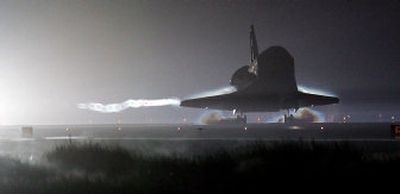
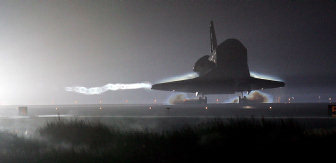
He spoke several hours after shuttle commander Brent Jett Jr. guided Atlantis to a perfect landing at the Kennedy Space Center, ending a labor-intensive mission that delivered a new solar power unit to the space station.
“It was a pretty tough few days for us, a lot of hard work, a great team effort to get the station assembly restarted on a good note,” Jett said from the landing strip.
Launched from a pad just a few miles away, the astronauts engaged in three challenging spacewalks to install the 115-foot-long solar wings. The units will produce power for the half-built station, though not until the next shuttle crew – scheduled for liftoff in mid-December – completes a rewiring project.
“I think assembly is off to a good start,” Jett said after bringing Atlantis through a star-dotted, cloudless sky for the predawn 3:21 a.m. PDT landing.
Still, NASA’s mission-packed manifest provides little scheduling flexibility and the agency might lift post-Columbia restrictions on night-time blastoffs for the next flight, scheduled for December.
Those restrictions are in place so more cameras can monitor the process as engineers look for launch-related damage to the shuttle, but recent missions have been so clean that NASA is gaining confidence in its system.
“I expect we will, in all likelihood, be able to launch at night as early as STS-116 the December flight,” said LeRoy Cain, a NASA mission manager.