
Roadless timber ruling appealed
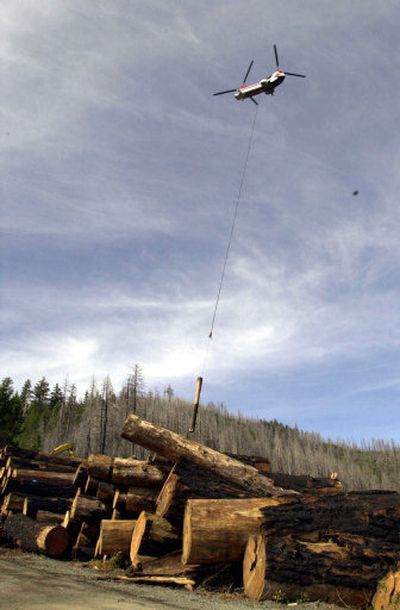
GRANTS PASS, Ore. – An Oregon timber company has filed the first appeal of this week’s ruling that reinstated protections imposed by the Clinton administration on 58.5 million acres of roadless areas in national forests.
Meanwhile, the state of Wyoming asked a federal court to reinstate a 2003 ruling that struck down the Clinton roadless rule, and conservation groups filed a motion to stop the U.S. Forest Service from going ahead with projects in roadless areas from New Hampshire to Oregon that were approved before the ruling.
U.S. Agriculture Undersecretary Mark Rey said the Bush administration was still considering whether to file its own appeal, but noted the government disagreed with a number of the findings, particularly the need to do an environmental impact statement.
Rey added that, so far, six federal judges have ruled on the Clinton roadless rule, three for and three against it, with no end in sight.
“By the time all is said and done there will be enough federal judges who have opined on the roadless rule so we could fill out a Major League Baseball lineup card and have plenty of judges left over for bench strength,” Rey said from Washington.
On Wednesday, U.S. District Judge Elizabeth Laporte in San Francisco overturned the 2005 Bush administration roadless rule that gave states a chance to seek logging, mining and drilling inside roadless areas of national forests, which are generally large tracts once considered for wilderness designation that have been untouched because of their remote and rugged terrain.
She reinstated the 2001 Clinton administration rule, which barred most logging and other development within roadless areas to protect them as prime fish and wildlife habitat and sources of clean water.
The notice of appeal was filed in U.S. District Court in San Francisco by Silver Creek Timber, which had intervened on the side of the Forest Service in the lawsuit, and has been logging trees burned by the 2002 Biscuit fire in two roadless areas of the Rogue River-Siskiyou National Forest in Oregon. Conservation groups have been trying to stop the logging but repeatedly failed.
“We feel not only is the ruling in error, but that the operations on Biscuit have to continue,” said Chris West, vice president of the American Forest Resource Council, a timber industry group in Portland. “Twenty-one judges have already reviewed and decided Biscuit and not a single one has halted any of the operations, including this judge at an earlier chance.”
Silver Creek owner John West said he had no opinion on future logging in roadless areas, but felt the latest ruling allowed him to go ahead with salvage logging the Mike’s Gulch and Blackberry timber sales, because the Clinton rule allowed logging after fires.
West added that all the trees to be cut on Mike’s Gulch were on the ground and should all be helicoptered out by next week, but logging will still be going on at Blackberry when attorneys are scheduled to meet with the judge Oct. 4 to discuss any work stoppages.
Wyoming Attorney General Pat Crank filed a motion asking a judge there to reinstate a 2003 ruling out of the U.S. District Court in Wyoming that struck down the Clinton rule. The ruling was vacated by the 10th U.S. Circuit Court of Appeals as moot after the 2005 Bush administration rule was adopted.
“In our estimation you don’t need a national rule like either of these rules,” Crank said from Wyoming. “We want to move the forest planning process as close as we can to the people affected by the decisions.”
Conservation groups filed a motion asking Judge Laporte to clarify her injunction after the Forest Service said it would go ahead with projects in roadless areas that were approved before the ruling.
Rey said the Forest Service feels roadless projects approved prior to the ruling do not come under the injunction.