
Competitive nature
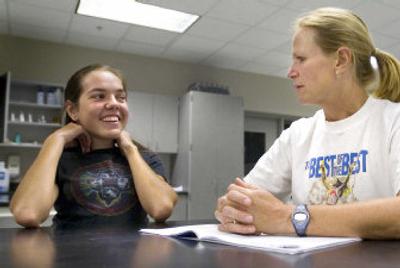
The cross country season has only just begun, but already Central Valley High School senior Krystle Horton has left her mark on the sport.
As slight as she is soft-spoken, Horton was born with infantile idiopathic scoliosis, a curvature of the spine, and without the lower lobes of her lungs. Asthma is an additional challenge.
Horton walks but when she competes, she does it in a wheelchair.
Horton competes in both cross country and track at Central Valley and plays basketball with Team St. Luke’s, part of the St. Luke’s Rehabilitation Institute. She’s done Bloomsday twice and celebrated the Fourth of July by doing the Peachtree Road Race in Atlanta.
Horton first turned out for track as a sophomore. This is her first season in cross country.
“I really enjoy cross country,” Horton said. “What I like about it is that it’s not just going round and round a track. The scenery changes; the terrain changes. It’s more of a challenge.”
Horton’s progress has been remarkable thus far this season.
“I used to at least be able to keep up with Krystle on the hills,” assistant coach Jennifer Stalwick said. “She would always kick my butt on the level. Now I can’t even keep up with her on the hills.”
Several Greater Spokane League teams have wheelchair athletes turned out for the sport this season. At Wednesday’s three-team meet at Central Valley, all three teams, CV, Rogers and North Central, had wheelchair athletes entered.
“We compete on the same course as the able-bodied runners,” Horton explained. “Sometimes it’s not accessible and we’ll have an alternative course laid out for us. That’s the case here at Central Valley.
“Most of the weekend invitational courses we run on aren’t set up for us, though. I won’t be able to compete at Mount Baker, for example. That course is laid out on a mountain and there’s no alternative course.”
At present, there is no scoring for wheelchair athletes in cross country. The manual of the state’s governing body, the Washington Interscholastic Activities Association, makes no mention of wheelchair athletes.
Horton is working to correct those oversights.
Horton took a day off from practice Monday to travel to Renton, Wash., to address the WIAA.
“The way things are now, we compete but they don’t even mention us over the loudspeaker at most meets,” Horton said. “They told us they were going to have to discuss it and that they would get back to us within 24 hours. They called us back that afternoon and said that they would have to continue discussing how to go about doing it, but that when they took a vote on it, no one had said no.”
Considering the normal process for change with the WIAA, that response was the equivalent of a glacier dancing a jig.
“I was scared about talking to them because I’m still pretty shy, but I’m really excited about seeing these changes,” Horton said.
The changes in Horton have been equally impressive.
Blessed with a fiercely competitive nature, Horton was without an outlet until she found her way to Team St. Luke’s.
“My mom works at St. Luke’s, and the basketball coach would stop by her office to talk to her all the time on his way to practice,” she explained. “He talked her into bringing me in and having me practice with the team.”
It took some coaxing to get Horton into a wheelchair and out on the basketball court.
“At that point, I hated basketball,” Horton laughed. “I wasn’t interested in playing. Now it’s my second-favorite sport behind track.”
“She said she didn’t want to play because people would be watching her,” Team St. Luke’s head coach Teresa Skinner said. “I finally talked her into practicing with the team, but she didn’t want to play. I had to talk her into putting on a uniform and sitting on the bench when we played an exhibition at the State B. But I knew she wouldn’t just sit on the bench.
“Krystle played her first wheelchair basketball game in front of 8,000 people at the Arena.”
Skinner is impressed with Horton’s competitive nature.
“Krystle has come as far as anyone in all my years working with adaptive sports,” she said.
Over the summer, Horton competed at the World Junior Games in Ireland, earning a bronze medal in the 1500 meters. In addition to the Peachtree race she competed in the national Paralympic trails in Florida – an event that comes to Spokane in 2007.
“It’s so important for these kids to have this kind of an outlet,” Skinner said. “They need to learn how to relate to other people as teammates. All kids need that, but I think these kids need it even more than most.
“That’s why we’re so excited about getting to a point where these kids score in a track meet and in a cross country meet.”
At this point, only one state, Louisiana, scores wheelchair athletes in meets.
“And there’s money out there for college scholarships,” Skinner said. “One of Krystle’s teammates at Team St. Luke’s just graduated with his Associate of Arts degree and has an $8,000 scholarship as a wheelchair athlete at the University of Illinois.
“The opportunities are there for Krystle as well.”
And, Horton said, there are opportunities for athletes to learn to compete through Team St. Luke’s.
“People should call Teresa at St. Luke’s,” she said. “Call 999-6466.”