
Secret of the sea
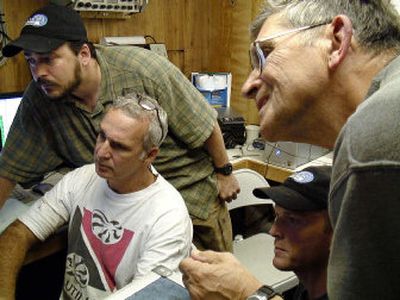

A marine geophysicist from Spokane played a key role last month in apparently unraveling a 64-year-old mystery from World War II: What happened to the USS Grunion, a submarine that vanished with 70 sailors aboard?
The work of 35-year-old Mike Kelly and seven other employees of a Seattle-based underwater exploration company helped locate what’s believed to be the wreckage of the U.S. submarine.
Using digital, computer-captured images from side-scan sonar, Kelly and his fellow scientists located the wreckage in more than 3,300 feet of water in the Bering Sea, northeast of Kiska Island in Alaska’s Aleutian chain.
“It was a thrill,” the 1990 Mead High School graduate said in explaining the discovery to his parents, Ed and Kati Kelly, of Spokane.
The privately funded scientific search expedition was sponsored by the three surviving sons of the submarine’s captain – men now in their 70s who grew old never knowing for sure what happened to their Navy father, Mannert L. Abele.
With the new sonar images captured by Kelly, the sons hope to return to Alaskan waters next summer with underwater cameras to further document the discovery.
“We’re 95 percent sure this is our dad’s submarine,” Bruce Abele said Wednesday when reached at his home in Newton, Mass.
The sonar images clearly show propeller guards which were unique to the USS Grunion and its class of submarines, Abele said.
The submarine’s probable final resting spot was located not only with high-tech gear, but also with newly discovered vital historical information posted on the Internet by two Japanese naval historians.
With that, the Abele family in May hired Williamson & Associate, where Kelly works as a marine geophysicist, usually mapping the ocean floor for cable and oil companies. The Seattle company previously found an Israeli submarine in the Mediterranean Sea and has looked for Amelia Earhart’s missing plane in the South Pacific. In the 1980s, the company found the wreck of the SS Central America off Charleston, S.C., and its reported billion-dollar booty.
“The whole crew was remarkable, but Mike is a phenomenal individual,” Abele said. “He was the key analyst who looked at the images and determined if it was a valid or useful target or a topographical image, like rocks.”
The work of Kelly and the other Williamson scientists was recorded on about 20 hours of video, which Abele and his brothers have reviewed.
“I can tell how closely they’re getting to the spot by watching Mike chewing gun,” Abele said. “The closer they get, the faster he chews.”
Besides finding the final resting spot of the USS Grunion, Kelly also spotted what’s believed to be the remains of two World War II Japanese “sub-chasers” in another location, tucked between undersea rock formations, Abele said.
The Williamson crew sent 11 sonar images via e-mail to Abele’s home, where he’d get up at 2 a.m. EST to monitor that day’s progress. “It was better than any movie you’d go to,” he said.
Now producers of documentaries and TV news shows, including “Today,” are lining up to tell the story.
But what’s important, Abele said, is this summer’s discovery answered a lifelong mystery for him and his two brothers.
“We grew up not knowing for sure what happened to our dad and now – 64 years later – we have some answers, which makes it all so unbelievable,” the 77-year-old said.
The 312-foot-long, 1,526-ton “Gato-class” submarine was built in Groton, Conn., launched in December 1941 and sent to the North Pacific the following May to hunt for enemy ships as the Japanese were establishing a forward base on Kiska Island in the Aleutian chain.
After its crew reported firing torpedoes somewhere northeast of Kiska Island on July 30, 1942, the USS Grunion vanished without providing precise location information to U.S. military.
Its whereabouts and the fate of its 70-man crew remained a mystery until Abele’s sons used the Internet in 2004 to make contact with two Japanese historians, Yutaka Iwasaki and Minoru Kanara.
“They gave us a close location where to look,” Abele said.
The historians had researched Japanese military archives and spotted logbook details from the Kano Maru, a Japanese freighter. Its crew, the historians said in an Internet posting, reported their ship was disabled after being hit in the machinery room by a torpedo from the USS Grunion (SS-216).
Following that hit, the Kano Maru crew fired two three-inch deck guns and a .50-caliber machine gun at the Grunion, which had surfaced about 400 meters away, possibly with mechanical trouble.
One of the shots, the Japanese historians wrote, hit the conning tower of the submarine, moments before it slipped beneath the surface.
The Abele brothers – Bruce, Brad and John – were told their father and his crew may have been taken as prisoners of war or vanished when the submarine experienced underwater mechanical problems. A U.S. destroyer was named after Mannert L. Abele, but it was sunk by the Japanese in Okinawa during a later phase of World War II.
After getting the new leads from the Japanese historians, Bruce Abele and his brothers began looking for an underwater exploration company. They found the Seattle-based company which does deep-ocean surveying for pipelines and oil exploration.
The funding largely came from his John Abele, of Vermont, who is the founder of Boston Scientific, the world’s largest maker of cardiovascular catheter equipment, Bruce Abele said. He wouldn’t disclose the cost of the privately funded sea hunt or give the precise location where his father’s submarine is believed resting.
Kelly has traveled the globe with the company after getting his geophysics degree from the University of Colorado at Boulder. He currently is in Paris, awaiting another sea-search beginning this weekend off the coast of Angola. He couldn’t be reached by phone on Wednesday.
Kelly and the other seven Willliamson crew members, including Jay Larsen, of Whitefish, Mont., met in Dutch Harbor, Alaska, in early August, said survey manager Art Wright.
The crew put their scientific gear, including computers and two deep-ocean sonars and winches, aboard the Aquila, a 165-foot crabber boat based in Seattle. The fishing boat’s owner, Kale Garcia, of Seattle, agreed to join the hunt between his Alaska fishing jobs.
The side-scan sonar devices were lowered to about 1,000 feet off the ocean floor, initially capturing images in a 3,000-meter swath.
When Kelly and the crew spotted something interesting on their computer screen on Aug. 14, their ship returned over the area for a narrower 375-meter swath, giving a much-more defined image of the submarine’s hull on Aug.17.
“The job was a real thrill, and we’re very satisfied our plans worked,” Wright said Thursday from his Seattle office.
Kelly analyzed the recorded computer images being sent from the underwater sonars, being tended by survey technicians. “He was a key guy, our processor,” Wright said. “He is the one who does the images and sorts through the data.”
At the Seattle office, the analysis of the data continues, Wright said.
“Nobody accepts it for 100 percent until you go down with cameras, but here in the shop we feel it’s a 95 percent probability it’s the Grunion,” he said. “Excited? Nah. This is what we do for a living. We’re a bunch of low-key guys.”