
Young workers in demand

With a bit of prodding, Sue Wirsch reveals parts of her strategy for filling 210 summer jobs at Black Rock Development’s golf course, marina and clubhouse on Lake Coeur d’Alene. But she won’t tell all.
“I have to keep a few secrets,” Wirsch, Black Rock’s human resources manager, says with mock coyness.
Understandably so. It’s competitive out there.
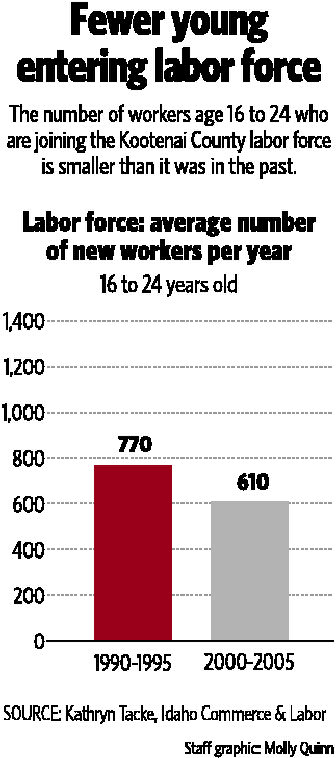
Black Rock is vying with other firms for a limited pool of workers. While North Idaho’s hospitality industry has grown rapidly over the last several years, fewer 16- to 24-year-olds are entering the labor force. Companies that hire youth and young adults are feeling the pinch.
While young workers – teens in particular – face double-digit unemployment rates in many parts of the nation, they’re eagerly courted in Kootenai County. Unemployment rates for that 16- to 24-year-old crowd are estimated at an enviable 5.3 percent in the county, according to state figures.
Though comparable figures weren’t available for Spokane County last week, demand for youth workers – while strong – doesn’t appear to be quite as intense across the state line.
“We’re not really seeing a tug and pull from the marketplace,” said Nancy Goodspeed, spokeswoman for the city of Spokane Parks and Recreation Department, which is a large employer of youth during the summer months.
In North Idaho, the market for seasonal workers began tightening about three years ago. Employers credit a variety of factors. With the economy growing, young workers have more job choices. Demographic changes also mean that fewer 16- to 24-year-olds entering the workforce.
For many local companies, the scramble for summer help begins shortly after the office Christmas tree comes down.
Silverwood Theme Park needs to hire about 800 workers for its summer operations. Wild Waters in Coeur d’Alene has 100 positions to fill, including 60 lifeguard hires. Restaurants, hotels and retail outlets also depend on youth workers to beef up their staffs for the summer months.
To get a jump on the competition, “we started 60 days earlier this year,” Wirsch said.
By late January, she was sending out letters to people who were on Black Rock’s payroll last summer, asking if they wanted to return to their jobs as bartenders, cooks, receptionists and housekeepers. Not all of the workers are students, but they’re a target hiring group for The Club at Black Rock, a nearby marina and other company properties.
“We think if we get them started in high school, they’ll stay on with us during their college years,” Wirsch said.
Next on Wirsch’s recruitment list were the community colleges, where she hired students in turf management programs to work at Black Rock’s golf course. Then, she held job fairs.
Wirsch said she has a couple of other hiring strategies, but she’s not revealing them.
With an opening on the first weekend in May, Silverwood Theme Park also starts recruiting early in the year. The park relies on radio advertising, using stations from easy-listening to rock “so we reach Mom as well as the young people,” said Nancy DiGiammarco, the park’s marketing director.
In February, Silverwood held the first of its onsite hiring fairs. The park also recruits aggressively at schools. This year, Silverwood’s starting wages for 16-year-olds increased 75 cents per hour to $7 , an acknowledgement of rising gas prices as well as demand for student workers.
Having rides and water slides helps attract young workers, managers at Silverwood and Wild Waters said.
“It’s much better than … working over a grill,” said Stacey Lavin, a consultant to Wild Waters.
But both parks said they’re putting an increasing effort into recruitment. In addition to competing with each other, companies that employ students are also up against extracurricular summer activities, such as sports and Advanced Placement classes with homework.
“Not all parents want their kids to be working,” DiGiammarco said. “I often hear, ‘No, we want them to focus on academics, to do well in those advanced courses … or to be available for family vacations.’ “
Nationwide, teens’ participation in the work force is gradually dropping. It’s an interesting development, said Barry Asin of Staffing Industry Analyst, a firm in Los Altos, Calif., that tracks labor market trends.
“People are in many ways wealthier than they ever have been so the impetus and need to have teenagers working is less than it was 20 years ago,” he said. “More teens are looking for things that will help them get into college as opposed to a summer job.”
For Miekle Korton, however, all the time-honored reasons that teens look for jobs apply. Last year, she rode her bike two miles each way to a concession job at Silverwood. She’ll be back again this year.
“It was either work at Silverwood or stay home and baby-sit,” the 15-year-old explained. “I want to be independent and not always have to ask my parents for money.”
Nichole Yates, 14, already has plans for the money she hopes to earn this summer. She wants to upgrade her cell phone plan so she doesn’t have to purchase pre-paid cards.
“Kids always want money, and your parents aren’t rich,” explained Yates, as she waited for her interview at Silverwood’s job fair last month. Her friend, 14-year-old Jeffery Plummer, came, too. His parents expect him to pay the $185 fee for driver’s education next school year.
“They think if I work for it, I’ll take it more seriously,” Plummer said. “I think it’s a good idea.”
Sharon Yates, Nichole’s mom, agreed. Earning and spending money is a rite of passage to adulthood, she said.
“You’ve got to work for your money to really appreciate it,” she said. “And you’ve got to learn how to stretch it.”
Stretching it is the hard part, the teens agreed.
“I missed the dance last Friday because I didn’t have the money,” Plummer said. “It was only $3, but I didn’t have it.”