
Shelter sets no-kill policy
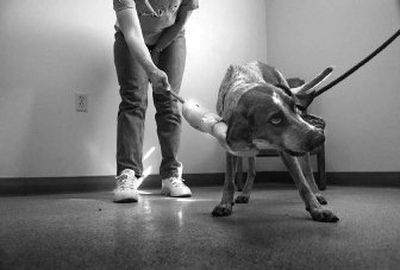

Arthur was as nervous as a college student before a final exam.
Only for Arthur – he’s a stray dog turned in to SpokAnimal CARE – passing this test was a life-or-death matter.
If Arthur failed, he would be euthanized. Passing made him eligible for adoption.
SpokAnimal volunteers Cathy Fox, Pat Moberly and Laura Felgenhauer put Arthur through a 14-step exam to measure his sociability, reaction to other animals, response to stimuli, dominance and sensitivity.
Arthur, if anything, is shy, but he passed the tests easily and was sent back to the SpokAnimal kennel, at 710 N. Napa St., with the seal of approval for adoption.
The temperament test is the heart of SpokAnimal’s effort to match dogs and cats with new owners. It is also the key to SpokAnimal’s goal of becoming what’s known as a “no-kill shelter.”
“No kill” means that no dogs or cats that are suitable for adoption will be euthanized.
Experts say it’s a lofty goal, one that is not likely to be achieved.
“In theory it’s a beautiful concept,” said Fox, of Paw and Order K-9 behavior services. “It will be a challenge to achieve.”
But the folks at SpokAnimal are serious about no-kill. The shelter, which has provided animal control services under contract to the city since 1984, is in the midst of a transition to the no-kill concept. SpokAnimal has notified the city that it wants to end its contract for animal control as part of its move to this new kind of shelter. City officials are debating how to replace SpokAnimal, either by forming a new animal control bureau or by contracting with Spokane County Regional Animal Protection Service.
Without responsibility for dog- and cat-catching, SpokAnimal can turn its attention to adopting out healthy pets, and there are some substantial grants available to help the shelter achieve the goal, said director Gail Mackie.
No-kill, she said, “is something that is on the forefront of every agency’s dreams and wishes.”
Spokane County’s other animal welfare agencies also are seeking to achieve no-kill status, Mackie said.
In 2004, representatives of animal welfare agencies throughout the country gathered in Asilomar, Calif., to hammer out definitions of what it means to be a no-kill shelter and to promote establishment of no-kill shelters around the United States.
The No. 1 premise of the accords is to save all healthy and treatable companion animals, bringing an end to euthanasia for animals that might otherwise be adopted.
The accords go on to define healthy animals as those that are at least eight weeks old and have no signs of behavioral or temperament problems that could pose a health or safety risk.
This is where volunteers like Fox, Moberly and Felgenhauer come in. Several times a week, they go to the shelter and test animals that have been recently received.
Dogs and cats are rated for their suitability around children and adults. If an animal has behavioral or temperament problems, they are available only to someone who is capable of providing treatment or rehabilitation.
So far, the effort is working. SpokAnimal has not euthanized a healthy, adoptable pet in a year or more, Mackie said.
In 2006, the shelter euthanized eight healthy dogs and 38 healthy cats.
“We’re just adopting like crazy,” Mackie said.
But SpokAnimal’s goal of becoming a no-kill shelter does not mean that all animals will be kept alive.
Animals that are sick or vicious or dangerous are still being euthanized regularly. About 9,000 cats and dogs were put down last year, many of them with contagious illnesses such as kennel cough.
Of the 5,000 cats that were taken in by the agency, only 259 were reclaimed by owners versus 1,564 dogs that were reclaimed.
“It’s a throw-away society, and cats more than dogs are thrown away,” Mackie said.
At the heart of the no-kill concept is public education and stepped-up sterilizations.
Currently 95 percent of licensed cats are sterilized, so it is apparent that responsible pet owners are getting the message about the need to control cat populations.
Vouchers are available as part of the city’s pet licensing system to offset most of the cost of sterilizations. Licenses for sterilized pets are less expensive, too.
SpokAnimal is working with volunteers in an effort to control wild cat colonies. They plan to set traps for the cats, and then have them sterilized before returning them to the wild. Each sterilized cat will be marked with a notch in its ear so that if it is trapped a second time, volunteers will know that it can be released back into its environment without posing a threat of reproducing.
The agency is also working with local retailers, schools and volunteers to adopt more of its animals.
SpokAnimal is promoting better practices among pet owners. It has a series of recommendations for controlling barking dogs. For example, a neighbor could buy an electronic device that will stop barking in an adjacent yard. A barking dog complaint, signed by three neighbors, could result in a $500 fine, Mackie said.
Also, SpokAnimal is asking local officials to enact an ordinance to outlaw the practice of chaining an animal for more than 10 hours a day.
The agency also has ideas for improving animal owners’ relationships with their pets.
“There’s a ton of stuff for you and your dog to develop your relationship,” Mackie said.