
Parenting in poverty
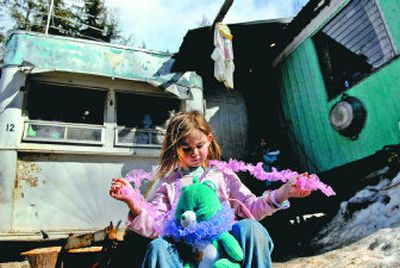
RAPID LIGHTNING, IDAHO – Several miles down a pocked and muddy road, past the wooden bridge over Lightning Creek, around the last bend from the snowbound carapace of a Chevy Suburban, sits a two-bedroom, half-century-old, single-wide trailer, home to three generations of the family Bonagofski.
Lacking running water, the Bonagofskis often shower at a little market eight miles away, at a price of $3 a person. In particularly lean times, the family uses jugs to haul water to the mobile home on the hill, and the youngest receive sponge baths in the family tub. On warm summer days, the Bonagofskis bathe under an outdoor shower, or swim nude in Lightning Creek, where the tracks of moose and bear crisscross the loamy soil.
Living at an elevation of 3,000 feet on the edge of the Kaniksu National Forest, the family finds winter to be more challenging. The snow and mud have claimed several family cars in recent years. This year’s drifting snows enveloped a bulldozer, a swing set and a $10 kitchen stove bought for parts at a thrift store.
“We’ve had our adventures here,” said Carlene Bonagofski, the family’s 36-year-old matriarch. “Once you head off Rapid Lightning road, it’s a different world.”
Their unorthodox lifestyle has attracted unwanted attention. Idaho social workers have launched a half-dozen investigations into the children’s welfare, according to the family. Those investigations pitted the Bonagofskis against one of the few agencies equipped to help them improve their lives.
The child welfare investigations infuriated Jerome “Jerry” Bonagofski, who, in descriptive language, ordered the last social worker to leave two years ago.
“They don’t like us not having real power or running water,” Jerry Bonagofski said, steadying himself on an aluminum cane. “But our kids are safe. They’re happy. They’re warm. They investigated us and found nothing. Finally, I got in their face and said, ‘Don’t come back here unless you’ve got a damn good reason.’ We’ve been out here surviving for quite a few years, and we ain’t dead yet.”
Carlene Bonagofski nodded in agreement.
“Anybody messes with my family, and this mama gets real upset,” she said. “Why take a child from a parent who loves them?”
Independent, needing help
The Bonagofskis are, in descending order, ages 46, 36, 23, 17, 13, 7, 6, 5, and 4. From grandparent to grandchild, they tend to be broad-shouldered, ruggedly self-reliant and unmistakably fond of their 30 acres of Idaho wilderness.
“I knew I belonged up here my first year,” said Carlene Bonagofski, remembering the family’s decade in the woods. “My neighbor shot a bear – because it was threatening his family – and he grabbed a paw and I grabbed a paw and we started hauling. I got going so fast he said, ‘Slow down! You’re dragging me too!’ “
Though neighbors are quick to help, or to offer a warm shower, the Bonagofskis’ individualism has, in some respects, left them increasingly isolated. In the past decade, they have gradually moved further from the grid of modern life.
Hampered by diabetes and degenerative arthritis, Jerry Bonagofski, a former computer technician, has been unable to work for years. He remains at home to educate his children, with a particular focus on 13-year-old Jacob, who left school last year after a district official complained about the odor of the boy’s jacket, which led to an escalating confrontation between the family and the school district and an interruption in Jacob’s public education.
“Somebody didn’t like the way he looked and threw him out of class,” Carlene Bonagofski said. “Our government just doesn’t understand that poor people like us are happy. My kids are the first thing I think of. I take care of my family before I take care of myself.”
Indeed, her teeth have rotted to her gums. Jerry Bonagofski’s arthritis could force him into a wheelchair in the next year. Her part-time job as a cashier does not provide health insurance.
“We could really use our government’s help,” Carlene Bonagofski said. “It’s hard. I won’t say it’s been easy.”
Poverty can breed neglect
In his classic 1978 article, “The Myth of Classlessness,” Leroy Pelton argued that poverty and child neglect are so intertwined that it becomes difficult to separate the two.
Federal statistics support the notion. Children whose families fall below the federal poverty level are 20 times more likely to be maltreated, according to the most recent data from the U.S. Department of Health and Human Services.
The work raised a fundamental question: At what point, if any, does poverty itself become a form of neglect?
For Pelton, now a professor of social work at the University of Nevada-Las Vegas, the answer was clear.
“Poverty itself can be remedied,” Pelton said in an interview last month. “If the parents are not bad parents, it’s a tragedy if the children are being removed. Why not try to remedy the poverty situation?”
Pelton’s argument, laid out in a second article nearly two decades ago, called for a massive overhaul of America’s child welfare systems, which continue to spend vast sums on investigating and litigating claims of child abuse and neglect but a relative pittance on preventive services to support families.
“Children are still being removed today because of poverty,” Pelton said. “I think (the problem) is a failure to focus on preventive services. States are spending a lot of money to separate the children from their families that they could have spent to help them.”
The larger problem – even broader than the structural obstacles of the child welfare system – is in the way Americans think about poor people, Pelton said.
Born into a family of migrant laborers, Donna Beegle became intimately familiar with stereotypical views of poverty: Lazy. Unintelligent. Criminal.
In the 1960s, Beegle’s family followed the fruit-picking seasons in California, Oregon and Washington. When the picking ended, the family went to the forests and stripped moss and bark from trees and sold it to nurseries for mulching.
Her parents worked long hours. But the family faced a constant cycle of evictions, hunger and scorn.
“We pretend that all you need to make it is hard work,” Beegle said last month, during her keynote address at a conference on child abuse and neglect prevention in Boise. “Poverty is not a subject our country has been real comfortable talking about.”
When the family sought help, Beegle only felt more isolated.
“What I learned early on was that no one cares,” she said. “Almost always, the people who were running those agencies, there was plastic or glass between those people and my parents. … I know that feeling. I want people to see what it feels like.”
A high school dropout and a wife at age 15, Beegle struggled through a divorce, homelessness and an overwhelming feeling that others viewed her with contempt. The stress affected the way she responded as a parent, she said.
Yet she emerged from poverty step by tiny step. She earned a GED, then an associate’s degree. A bachelor’s. A master’s in communication. A doctorate.
“The isolation of poverty perpetuates it,” Beegle said. “There is a huge fear of people in poverty. But just because someone doesn’t do things the way you do, it doesn’t mean they don’t care about their child.”
Social workers, teachers and others must empower families, rather than tear them down, Beegle said.
“If you want to prevent child abuse and neglect, you’ve got to start teaching people what’s right about them,” she said. “It may not be in your job description. But you have to ask yourself, ‘What’s in your hands? Who do you know who can help?’ “
While Beegle survived and eventually thrived, countless others have not.
Research has established that poor children are more likely to be maltreated. Poverty has been linked to measurable physiological changes in brain development, growth and responses to stress.
“You can be poor as a church mouse and bright as a bulb,” said Dick Cvitanich, superintendent of Pend Oreille School District No. 84, where half of the students qualify for free or reduced-price lunches. “But there are some correlations between poverty and student performance. We have children living in very difficult situations, and when they get to our school, they just aren’t ready for it.”
Public school and confrontation
Last year, Jerry Bonagofski decided he’d had enough of Idaho’s public school system.
For years, the Bonagofskis had welcomed help from Northside Elementary School, where teachers allowed the children to shower, do laundry and eat twice a day.
But as the children moved into middle school, the Bonagofskis worried that school officials were repeatedly referring them to Idaho’s Department of Health and Welfare. Frustrated, the family removed the children from school, and Jerry Bonagofski took on the task of teaching his children in the small mobile home while his wife worked part time as a cashier at Wal-Mart.
“It’s harder than I thought,” said Jerry Bonagofski, who has an associate’s degree in computer science. “Jacob does seem to have a learning disability, but nobody’s ever figured it out.”
Jacob said his stress in public schools grew as his grades slipped.
“I tried to pay attention to the teacher, and then something would happen over here and I’d just look over at it,” he said. “My science teacher was stressing me out because he kept saying I might not pass, and I kept worrying and I couldn’t concentrate.”
The Bonagofskis plan to move Jacob to an alternative school, a change that appeared to excite him.
“That’s the first school I’ve seen with stairs in it,” Jacob said.
The family worries that teachers will again contact welfare workers. State policy in Idaho and Washington clearly states that children cannot be removed for poverty alone.
But while some of the family’s interactions with social workers were positive, many of the visits began to feel like interrogations, Jerry Bonagofski said.
“I’m tired of fighting with the government,” he said. “Instead of helping you, they want to hassle you.”
Here in the North Idaho wilderness, disconnected from the amenities of the modern world, the Bonagofskis lit upon a fundamental problem of child welfare systems: They have come to be viewed as a threat to families, not an asset.
Seventeen years ago, a federal advisory board lamented the state of the national child welfare system, stating, “It has become far easier to pick up the telephone to report one’s neighbor for child abuse than it is for that neighbor to pick up the telephone and receive help before the abuse happens.”
Four years ago, federal officials reported the results of a study of all children who were referred to the child welfare system. Of those who were not found to be victims of maltreatment, only one in four received services.
Long-term desires, immediate needs
On the bad days, Carlene Bonagofski drinks her meals. Maybe ice cream. Or Jello.
Her 11 abscessed teeth not only frequently prevent her from eating solid food but also could threaten her life if the infection spreads. She is painfully self-aware of her missing teeth. The bill to repair them could be more than $4,000, she said.
“I just wanted (insurance) for a couple of months to get my teeth fixed so I can feel good about myself,” she said, briefly losing her optimism. “There’s times my jaw’s so sore I can’t eat.”
Carlene Bonagofski doesn’t qualify for Wal-Mart’s company insurance, and prescription medication is out of reach. The state’s Medicaid program covers the children. But to qualify for public health care in Idaho, Jerry and Carlene would have to earn less than $512 a month.
Free dental programs do exist, but the family has had trouble locating them. Carlene Bonagofski has heard that a mobile dental van visits Sandpoint in the summer but that it’s stationed in Bonners Ferry during the winter. Her van, she said, would be unlikely to survive such a lengthy venture.
As for Jerry Bonagofski, a physician in Sandpoint has agreed to treat him for $5 per visit. But he worries that by the end of the year he may be unable to walk. There is talk of building a wheelchair ramp up the icy slope to the mobile home.
One of the family’s only links to government programs – through their children’s former social worker – has been severed. Anger and distrust now permeate the Bonagofskis’ conversations about public workers.
“I love my country,” Jerry Bonagofski said, “but I don’t trust my government.”
The distrust only grew in January.
At the bottom of the hill below the Bonagofskis’ home, in a tiny camper festooned with a flag (“The beatings will continue until morale improves”) lived Amanda Barney, her fiancé Scott Gregory, and Amanda’s infant son, Dominic – who, with the aid of concerned relatives, was seized by the state of Idaho in late January.
The state alleged marijuana use, drinking by adults and neglect because of the lack of running water, Gregory acknowledged. State officials said they could not discuss individual cases.
“They say we’ve either got to move or we’ve got to get water in there,” said Gregory, a hulking 34-year-old former truck driver with broad shoulders and a degenerative bone disease. “But every place you look, they want first and last month’s deposit. If you find a place for $500 a month, that’s $1,500 upfront. We don’t have the money.”
Jerry Bonagofski shook his head as his neighbor spoke.
“We’re just trying to survive,” he said. “Yes, I heat my water on the stove, but my life’s exactly the same as everyone else. If I lost my kids, I’d lose my mind.”