
Tundra joins ‘battle of behemoths’
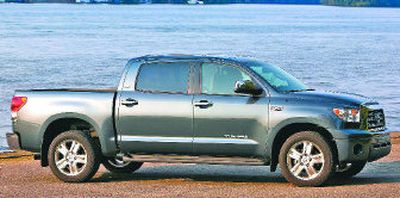
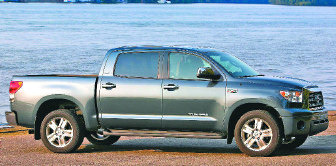
Toyota is the beast from the East, the Big Bad Wolf of automakers, the invincible Mongol horde.
Unstoppable. Unflappable. And damned unnerving, if you happen to be a domestic maker.
Name a significant market segment and Toyota, or its Lexus subsidiary, is in the thick of it.
All but one, that is: Full-sized trucks are the last stronghold of the domestic automakers.
Now, a confident Toyota wants to take away even that advantage.
Toyota’s second-generation Tundra is larger in every dimension than the not-quite-full-size truck it replaces. It was designed and engineered in the U.S. and is built in Texas.
It will, says Toyota, carry “everything but excuses.”
Beyond the Hype
Marketing hyperbole aside, how does the new Tundra stack up? Will it dominate in its category as the Camry does in the midsize family market or the ES 350 in the entry-luxury segment?
The short answer: Not likely.
Though it lacks a diesel option, the Tundra is as capable as anything Detroit offers. Loyalty runs deep in the truck market, though, and buyers need a darn good reason to switch.
Toyota has the resources and the will — to fight a long, hard battle, which is what will be needed.
Incentives Already
There are early indicators of the struggle ahead.
This week, Toyota announced a second round of Tundra incentives. Now, buyers can combine a $1,000 trade-in incentive with an existing cash-back offer of up to $2,000.
Incentives come with the category, says Toyota.
“In the truck segment, the customers really do expect them,” spokesman Denise Morrissey told Automotive News.
As if to prove her point, General Motors announced on Wednesday modest incentives on full-size trucks.
Toyota priced Tundra aggressively out of the box. Its base price is some $1,000 higher than its rivals’, though standard features compensate.
The Tundra is available in Regular Cab (from $22.935, including destination), Double Cab ($26,750) and CrewMax ($30,320). Four-wheel drive runs another $3,000.
The Double Cab has four front-hinged doors and a full back seat. CrewMax’s has extra-large cab has a trunk-sized storage space behind the slide-and-recline rear bench and 44.7 inches of rear-seat legroom.
Standard features on all models include dual-zone manual climate control, AM/FM/CD audio, tilt-and-telescoping steering and a pair of 12v power points that stay live for up to two hours after shut-down.
Standard safety items include four-wheel disc brakes; ABS with electronic brakeforce distribution and brake assist; front- and side-impact airbags for front-seat occupants; roll-sensing curtain-style bags; and vehicle stability control with traction control and automatic limited-slip differential.
An optional TRD (Toyota Racing Development) Off-road Package is available on Regular and Double Cab V-8 models. It includes an off-road tuned suspension, 18-inch off-road tires, engine skid plates, tow hook and fog lamps.
Our Double Cab 4X4 tester was equipped with the off-road package and, with an unloaded bed, reminded me of what a real truck ride used to feel like (read: bouncy).
Three Gasoline Engines
A choice of three gasoline engines powers the Tundra.
A 4.0-liter V-6 makes 236-horsepower and 226 foot-pounds of peak torque and is standard on Regular and Double Cab models. A 271-hp/313 ft-lb 4.7-liter V-8 is optional on both and standard on CrewMax, while a 5.7-liter V-8 rated at 381 hp and 401 ft-lb is optional across the line.
Equipped with the 5.7-liter eight, the Tundra sprints from 0-60 in 6.3 seconds, or about as quick as the competitions’ performance models, which lack its utility.
At 14 mpg city/18 mpg highway, fuel efficiency is not its strong suite, although it and the six earn the ULEV II emissions rating.
A five-speed automatic is standard on the six and the smaller eight, while the 5.7-liter comes with a six-speed auto.
Tundra, which is available only as a half-ton, can be had in three wheelbases: Regular Cab with standard bed (126.8 inches); Regular Cab with long bed, Double Cab with standard bed and CrewMax (164.6 inches); and Double Cab with long bed (164.6 inches).
The 4x2 Regular Cab gets the highest tow rating, at 10,800 lbs; the 4x4 CrewMax the lowest, at 10,100.
Not Yet Godzilla
Styling is subjective, as always, but that massive grille indicates that Toyota is sighting on Dodge’s trucks.
To my eye, the interior is a take-it-or-leave-it affair. A large, metallic-look dash panel faces the driver and encompasses the center console, while the passenger side of the dash is covered in hard plastics.
The seats are large and comfortable and the knobs and controls large and logically arranged. In models equipped with the rear back-up camera, though, they are placed far to the right.
At this early date, the Tundra has not shown itself to the Godzilla of full-size trucks. Still, the domestics know enough to never write off Toyota; the battle of the behemoths has just begun.