
Work begins on downtown housing

Twenty-five years after completing its first major housing project in downtown Spokane, the region’s main housing authority is back in the neighborhood working on another project.
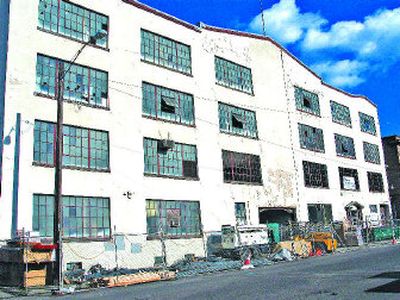
Northeast Washington Housing Solutions, also known as the Spokane Housing Authority, broke ground last week on a $10.2 million project to rehabilitate a four-story warehouse at 151 S. Adams St. into affordable units for working-class residents.
The 50-unit Cornerstone Courtyard Apartments is expected to open by the end of the year.
The housing authority’s first large downtown project, at the former Parsons Hotel at First Avenue and Jefferson Street, opened in 1982, also with 50 units for low-income senior citizens and people with disabilities.
City and project officials were joined by investors and neighboring business owners in celebrating the new job and unveiling a large cornerstone for the building last week.
The project is being hailed as a counterbalance to the growing number of upscale condominiums being developed in the downtown area.
“The more balanced the incomes, the better the mix,” said city Councilwoman Nancy McLaughlin.
The new apartment building is being fashioned out of a warehouse that 20 years ago served as home of Borning Corp., a Spokane-based company that manufactured an adjustable maternity bed. Owner and inventor Loel Fenwick sold his company and its range of products, including the Borning Bed, in 1987.
Parts of the building date to the early 1900s, when a furniture wholesaler operated there.
The housing authority purchased the building from Fenwick in 2004 for $1.3 million and held it through a bank loan until a state housing trust fund loan could be secured about 18 months later.
The bulk of the financing for the conversion is coming from low-income housing tax credits, which were awarded for the project by the Washington state Housing Finance Commission under a federal tax program that strictly limits how much money is available to each state for credits.
Winning the credits is competitive, said housing authority Commissioner Bill Zeck. The state receives applications for twice as much in credits as are granted each year.
U S Bank purchased the credits, which are worth $760,000 a year for 10 years.
Under the financing arrangement, the housing authority created a limited liability company and acts as general partner and manager of the project while U S Bank is the limited partner.
Other funding is coming from loans through the state Economic Development Department and federal HOME funds administered by the city of Spokane, and grants, including one for cleanup of lead paint.
Rent for the most-affordable units will be set at 40 percent of the area’s median income. Other units will rent at 50 percent of median income.
Rent will range from $398 a month for a one-bedroom unit to $697 for a three-bedroom unit, not including an electrical power charge of approximately $70 a month.
The mix includes 24 units with one bedroom, 16 with two bedrooms and 10 with three bedrooms. The building will have keyed entry, a community room with kitchen, study, office, family exercise room, courtyard and laundry.
Water, sewer and garbage service are included in the base rent, along with hot water.
Two adjoining structures – one built with concrete and the other wooden frame – are being melded into a single complex. A light well will be built into the central rear portion of the complex.
“It’s a challenge to make one building out of two,” said Brian Lloyd of Beacon Development Group of Seattle, which was hired to develop the project.