
What comes after veto is anyone’s guess
Congress has passed an emergency spending plan with billions for extra programs and timetables for withdrawing troops from Iraq – as expected.
President Bush is likely to veto it next week – as expected.
After that, no one knows what to expect, members of the Washington and Idaho delegations said Thursday.
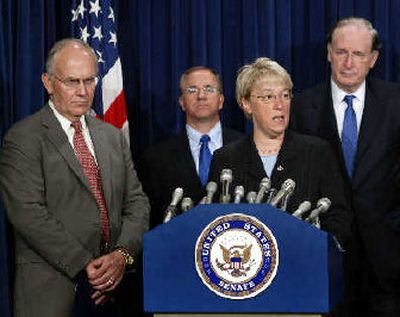
Washington’s Sen. Patty Murray, the fourth-ranking Democrat in Senate leadership, said the next step likely hinges on what the president says when he vetoes the bill.
“I’ll be listening for his tone, what he says and how he characterizes things,” Murray said. “He could say it’s time we sit down and talk.”
Congressional leaders met with Bush at the White House last week, but “I don’t think it was a listening session,” she said. If a new bill has to be fashioned in the wake of the promised veto, there may be more willingness to negotiate.
Idaho Sen. Larry Craig said Republican leaders will be looking for Bush to signal how much extra money he would accept in a new bill beyond what’s needed for the war in Iraq and Afghanistan. One of the president’s chief criticisms of the current emergency spending bill is that it contains about $24 billion for other programs.
“I think the president would accept some extra programs. That’s clearly part of what’s being talked about,” Craig said.
But he’s convinced that Bush will not sign anything with a timetable for withdrawing troops, and he suspects the Democrats realize that, too. Now that they held a vote on troop withdrawals and had a chance “to make a loud political statement,” they may propose a spending bill without those requirements, Craig said.
Murray said the vote was more than a political statement by Democrats. It was a change in direction for Congress, which had done little to question the administration during the previous four years, and a reflection of the public’s frustration over the war.
That’s something Republicans are also hearing when they return to their home states and districts, she said. “The vast majority of people want us to change direction.”
Sen. Mike Crapo, R-Idaho, said it’s probably true that the majority of the people in the country are frustrated with the progress of the war. But he doubts that a majority believe in setting a timetable for withdrawal from Iraq and announcing it to the other side.
“The issue carries potential political liabilities for both sides,” Crapo said.
He believes there may be a way to pass an emergency spending bill for military spending in Iraq and Afghanistan, and perhaps a few other national emergencies. After that, Democrats could bring up the question of troop withdrawal in a separate resolution for another debate in the future if they want.
But there is a danger with allowing anything other than military spending into the emergency appropriations bill, because almost everyone in Congress has a program they would like to have addressed. No one can predict where it will stop.
Craig and Crapo said they hope a new bill would include money for schools and counties in financially strapped timber areas, which are facing the end of federal payments. That’s in the current bill, but it might not make it into a new version.
Murray and Sen. Maria Cantwell, D-Wash., have argued that some of the domestic costs of the war, such as funding for military hospitals in the United States and veterans programs, belong in the bill.
“You have started down that road, once you have an emergency bill of any kind,” Crapo said.