
Lincoln enters crossover territory
There’s a sweet spot at the heart of every automotive segment, some combination of price, performance and content that defines the category.
Find the right combination and you’ll most likely have a hit on your hands. Miss it and your new baby becomes an asterisk.
Sales of Lincoln’s Aviator, a midsize sport-ute, never took flight, so Lincoln replaced it last year with the MKX, a midsize crossover-ute.
It’s more attractive, more comfortable and more economical than the Aviator. Those qualities along should ensure a modicum of success. If not, though, there’s always that X.
The beauty of X — or the misery of it, if you suffered through algebra like I suffered through algebra — is that it can stand for nearly anything.
In the case of the MKX, it could stand for 10, as some have supposed. It could stand for the sweet spot Lincoln hopes to hit. Or it could simply be a fashionable signifier, as in MDX (Acura), RX 350 (Lexus), RDX (Cadillac), X3 (BMW), XC90 (Volvo) and FX35 (Infinity).
In fact, says Lincoln, it stands for crossover, Lincoln’s first.
Fresh Sheet
The car-based MKX makes a clean break from the Aviator, which shared platforms with Ford’s truck-based Explorer.
First cousin to Ford’s Edge and kin to the Mazda CX-9, the MKX is available in a single trim level. It’s priced from $34,795, including destination, with all-wheel-drive starting at $36,445. Our well-equipped tester smacked up against the $45,000 mark, at $44,385.
Competitors include the crowd above, as well as such non-Xers as the Mercedes-Benz M-Class and Volkswagen’s Touareg.
Stiff company, in other words.
Decently Equipped
Every MKX is respectably well equipped, if not extravagantly so. Comfort and convenience items include leather seats with eight-way power adjustments, one-touch front windows, dual-zone climate control, leather-and-wood steering wheel and 18-inch alloy wheels.
A full array of safety gear includes traction and stability control, rollover mitigation, anti-lock disc brakes and a full set of airbags.
High-demand options are bundled in a set of packages and most are also available as freestanding picks. With some exceptions, buyers can upgrade to the features they want without having to spring for those they don’t want.
Third-row seating is notably absent. The MKX is strictly a five-passenger rig and Lincoln says a seven-passenger version is not in the cards, although a long-wheelbase CX-9 is in the offing.
The Business End
The MKX uses the same 265-horespower, 3.5-liter V-6 as found in the Edge. Paired with a six-speed automatic, the six supplies adequate though not overwhelming power. At eight-seconds plus, the 0-60 burst is more a trot than a sprint. The transmission is calibrated for economy, not power, which retards downshifts and further complicates passing.
Even with just one aboard, it’s best to have built up a good head of steam before swinging out into the oncoming lane.
Still, at 17 city/24 highway, fuel efficiency is not much better or worse than others in the class. The engine may be the best six Ford has made in some time. It runs smoothly at low and midrange rpms but gets noisy when pushed.
The suspension is fully independent and the all-wheel-drive system can allocate power front-to-rear and side-to-side. Like the system in Acura’s MDX, which we have long admired, it is calibrated to anticipate traction loss – say when the accelerator is floored – and proactively redirects power delivery.
Putting It Together
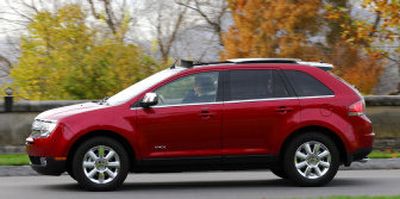
Unlike the Aviator, which resembled a mini-version of the full-size Navigator, the MKX gets a sleek shape more in keeping with class expectations. A high, chrome-accented beltline, sweptback windshield, black rocker panels and 18-inch alloy wheels produce a slick-and-quick look. A stylish chrome grille carries the Lincoln DNA more subtly than did the Aviator.
Interior styling is less successful, despite the presence of leather and authentic wood trim. Gauges are radiused at the corners for a squared-off, retro look and monochromatic buttons and switches reside on an instrument panel of the same, lifeless color.
In the Detroit tradition, the word Lincoln is spelled out in chrome block letters on the dashboard’s single piece of wood trim. Inexplicably, the wood steering-wheel inserts are placed at 9 and 3 o’clock, rather than at 10 and 2 where the driver’s hands rest.
Even in its dimmest night setting, the navigation display glows too brightly. Turn it off, though, and the clock and radio-station frequency indicator disappear.
And a final niggle: the optional seat-cooling devices formed a hard lump underneath the seat cushions. Not that it seemed to matter; I survived a six-plus-hour drive without discomfort.
The nicely weighted steering system has good on-center feel and the suspension is tweaked for comfort at the expense of performance. Consequently, the MKX is prone to body lean in fast sweepers.
In the end, despite its outward appearance, the MKX is a conservative entry in a category stacked with aggressors. If the category’s sweet spot proves broad enough, Lincoln’s first CUV could provide like-minded buyers with an altogether appropriate alternative.