
Spotted owl wanes despite protection
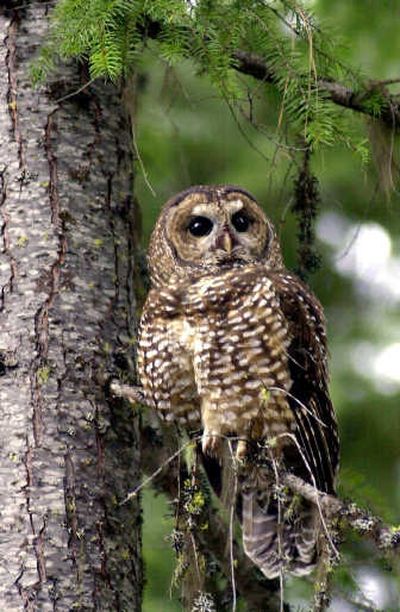
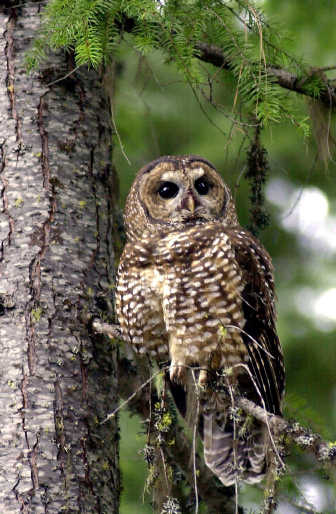
OLYMPIC NATIONAL PARK, Wash. – Two decades after the wrenching drive to save an obscure bird divided Americans and reshaped the economy of the Pacific Northwest, the northern spotted owl is disappearing anyway.
Even the most optimistic biologists now admit that the docile owl – revered and reviled as one of the more contentious symbols the nation has known – will probably never fully recover.
Intensive logging of the spotted owl’s old-growth forest home threw the first punch that sent the species reeling. But the knockout blow is coming from a direction that scientists who drew up plans to save the owl didn’t count on: nature itself.
The versatile and voracious barred owl is proving far more adept at getting rid of the smaller owl than the Endangered Species Act was at saving it:
•Fewer than 25 spotted owls remain in British Columbia, the northern fringe of its range – and where barred owls first moved into the West. Biologists say the best hope for Canada’s spotted owls would be for zoos to capture and breed them, and perhaps someday return them to the wild.
•Spotted owls are vanishing inside Olympic National Park, where logging never disturbed them. A biologist looking for them says it sometimes seems like searching for the long-lost ivory-billed woodpecker. Barred owl numbers, though, are “through the roof.”
•Researchers fitting owls with radio transmitters and tracking them in Oregon’s woods are finding more barred owls than anyone realized. A few decades ago, no barred owls existed there; now they outnumber spotted owls more than 2-to-1.
“It looks like we may have really underestimated the number of barred owls,” said David Wiens, a leader of the study based at Oregon State University.
Eric Forsman, a U.S. Forest Service biologist whose research put the spotted owl on the map, is helping oversee the study with Wiens. “I think we’re going to be depressed when it’s all over,” Forsman said.
The spotted owl was not the only reason for protecting Northwest forests, but it was the trigger. With its dependence on towering old trees, the owl brought the Endangered Species Act into play during the logging boom of the 1980s. Judges finally put a stop to the cutting that threatened it.
Sawmills were shut; thousands of loggers lost jobs. Technology and global trade were altering the timber industry at the same time, eliminating jobs, too, but the spotted owl came to embody a sharp and, for many, painful break from the region’s proud logging history.
Rural restaurants put spotted owls on their menus, and parade marchers burned the reclusive bird in effigy. T-shirts and bumper stickers urged: “Save a logger, eat an owl.”
“The spotted owl was really just a symbol for a much broader ecological and political debate,” Forsman said. “Regardless of what happens to the spotted owl, I don’t think that debate will change.”
Given enough protected forests, biologists thought, the spotted owl would rebound. They did not foresee competition moving in so fast.
The Endangered Species Act does not allow giving up on spotted owls. So federal biologists, under a new owl recovery plan, want to launch an assault on barred owls – shooting them out of some patches of forest to see whether it helps spotted owls.
But will that work any better?
“Unless you are prepared to remove barred owls forever, I don”t think it’s realistic,” Forsman said. “At best, we’re going to end up with some considerably reduced population. At worst, who knows? All species eventually go extinct. … That certainly could be the worst-case scenario, yes.”