
Natural forces at work on volcano
.
MOUNT ST. HELENS, Wash. – Forest or mountaintop, which will come first?
In a colossal race between natural processes, scientists are watching geological and ecological forces race each other in real time. Some are beginning to wonder whether the erupting mountain will rebuild its formerly conical top before a forest returns to its eruption-scarred surroundings.
“It really could be a kind of competition, so to speak,” said John Pallister, a geologist with the U.S. Geological Survey in Vancouver.
From the windswept pumice plain in the barrel of the Mount St. Helens blast zone, botanist John Bishop is closely tracking the progression of plant and animal life. Bishop, with Washington State University Vancouver, would place his bet on the mountain.
“It could be that some of these areas never recover to forest, at least not before the next eruption,” he said.
Based on the length of time scientists have calculated for a closed-canopy forest to return to an area northeast of the volcano cleared by a huge blowout in the late 15th century, Bishop said it could be at least 200 years for a forest to take root in the harsh environment of the pumice plain.
At the current rate of lava extrusion, meanwhile, scientists figure it will take 160 years for the volcano to rebuild the top 1,314 feet obliterated in the eruption of May 18, 1980.
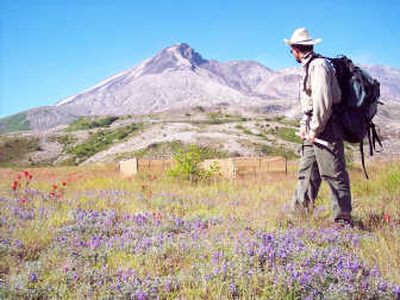
The eruption also cleared 230 square miles of alpine forest. It’s hard to recognize from the gray, flattened terrain visible from the high vantage point at Windy Ridge, but a closer examination during a hike through the pumice plain reveals life returning in a riot of color – yellow dandelions, purple lupines, scarlet paintbrush.
“It’s hard not to say, ‘Great, look at all these plants,’ ” said Bishop, who is in his 18th summer working near the mountain. “But it’s also coming back slowly.”
Using a $428,000, five-year award from the National Science Foundation, Bishop and colleagues from the University of Maryland have begun to focus on the effect of a nonnative type of beetle that’s invaded the pumice plain. During a field expedition at the end of July, the beetle was mainly evident from what it left behind: dead willow branches, and piles of sawdust-like frass (science-speak for bug poop).
In the stark and open environment of the pumice plain, scientists consider the willow and alpine lupine to be “ecosystem engineers” because they fix nitrogen in the developing soil. This, in turn, sparks a succession of life forms: moths and other herbivores that eat the lupines, followed by predators such as spiders that feast on them.
Anything that constrains the growth of willows and lupines effectively short-circuits the ecological procession.
Bishop said it’s no coincidence that, beyond streambeds where alder and willow now grow in thick clumps 15 feet tall, willows on the pumice plain are usually no bigger than knee-high.
“We think if there were no beetles here, these willows would get big and thick,” he said.
Nibbling elk, winter snow and 80 inches of annual precipitation also pose hurdles.