
Now history will take its swings
SAN FRANCISCO – Now, Barry Bonds is alone, however history will have him.
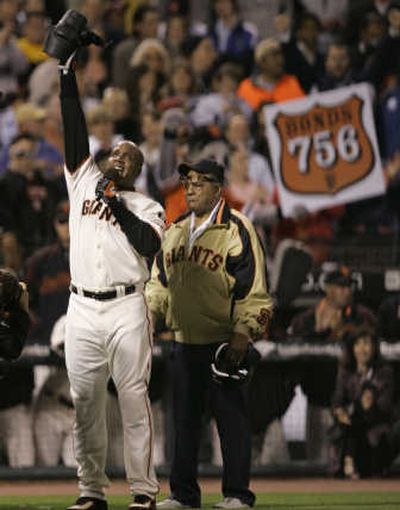
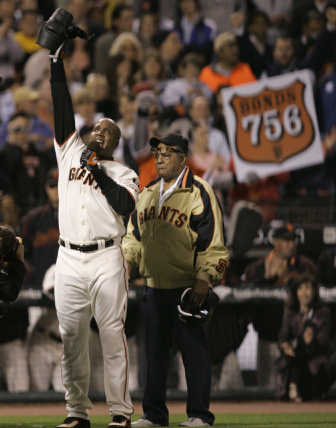
The inevitable became reality Tuesday night. No. 756, take it or leave it. With a truly majestic 435-foot blast into the stands in right-center field, Bonds left behind Hank Aaron, as he left behind Babe Ruth and Willie Mays and the thousands of other professional players who tried for 139 years to accomplish the purest of baseball feats – which is to take a bat and hit a ball over a wall.
Whether he did it purely is another issue, which is why the unconditional applause barely carried beyond the gates of AT&T Park.
This was not a party everyone wished to attend. The commissioner of baseball was missing (although Bud Selig called in congratulations). So was the man whose record Bonds bettered. Much had been made of Aaron’s absence at this moment.
But suddenly, there on the big scoreboard in center field, a taped message and the huge face of … Hank Aaron.
In his congratulations, Aaron hoped Bonds’ feat could be like his own … “to inspire others to chase their own dreams.”
So it was an immortal home run accompanied by varied noises. The instant Barry Bonds became the greatest home run collector of all time, some of the baseball world cheered, while some booed. And some just looked away, relieved it was over. But they will want it to be forgettable too much to forget it.
There has never been another event quite like it in baseball history; a number so glorious, a response so divided.
Not that people didn’t want to watch. Tuesday was the 28th straight sellout crowd before which the Giants have played.
Bonds dropped his bat and held his arms high as the ball flew away in the fifth inning – a no-doubter of a rocket on a 3-2 pitch from Washington’s Mike Bacsik, whose father pitched against Aaron 31 years ago, when Aaron was sitting on 755 home runs.
This story never ran out of remarkable twists.
And if some think Bonds’ total is artificial, his emotions this night seemed genuine enough.
After stepping on home plate, he pointed to the sky, to father Bobby, who died four years ago.
He took the microphone and thanked his teammates for their support. “I’ll never forget it as long as I live.”
He thanked his wife and kids and mother. And his dad, and it was then the voice of a man who can be so cold and distant broke. “Barry! Barry!” the masses here chanted, with the adulation he virtually never hears in any other ballpark.
“This is one,” manager Bruce Bochy said the other day. “that’s never been hit.”
When it comes to the actual numerical work of his chosen profession, Bonds has done all he can do. He has struck the last blow required.
He has made it to the top, if you ask the record book.
“What’s incredible about the home run record,” Bochy said, “is the number of times he’s walked.”
That would be 2,540, or 1,138 more times than Hank Aaron. As Bochy noted, just turn a third of those into at-bats, and consider what Bonds’ home run total would be.
As it is, he has passed a number the last generation considered nearly unassailable when it happened. Perhaps you haven’t read the quote on page 224 of the book “Hank Aaron and the Home Run That Changed America.”
“I don’t think that there is any ballplayer right now who will make it. For now, Henry Aaron is safe.”
The man who said that in 1974 was Bobby Bonds of the San Francisco Giants. His son Barry was 9 years old.
But the legacy of Bonds’ record is now to be shaped by grand jury findings, by future books and revelations and admissions and questions. It is now, as all legacies must be, left to time.
“We should just accept that he is a great player,” teammate Dave Roberts said the other night, “and enjoy the moment.”
But it is clear that is asking too much from millions – including some of baseball’s most famous faces. Selig recently called this mark the “greatest record in American sports.” Yet he was thousands of miles away Tuesday night, in body and spirit.
So ended the chase that began June 4, 1986, when a skinny Pittsburgh Pirate rookie named Barry Bonds hit a two-out solo home run in the fifth inning off an Atlanta Brave named Craig McMurtry.
The record can be defined easily enough by sheer numbers. The 756 home runs have come in 36 different ballparks … against 28 different teams.
But to define this record’s value, its propriety, its charisma, its very place in a game that cherishes numbers … that is work yet to be done.
Barry Bonds’ 756th home run came down in the distant stands of a relatively new ballpark that has teemed with customers because of him. But it will take time, maybe years, to decide just where that home run ball landed Tuesday night as far as its integrity … in fair or foul territory.
It was the night when Bonds took his biggest swing. But the question remains. Will it always be a home run hit in the shadows?